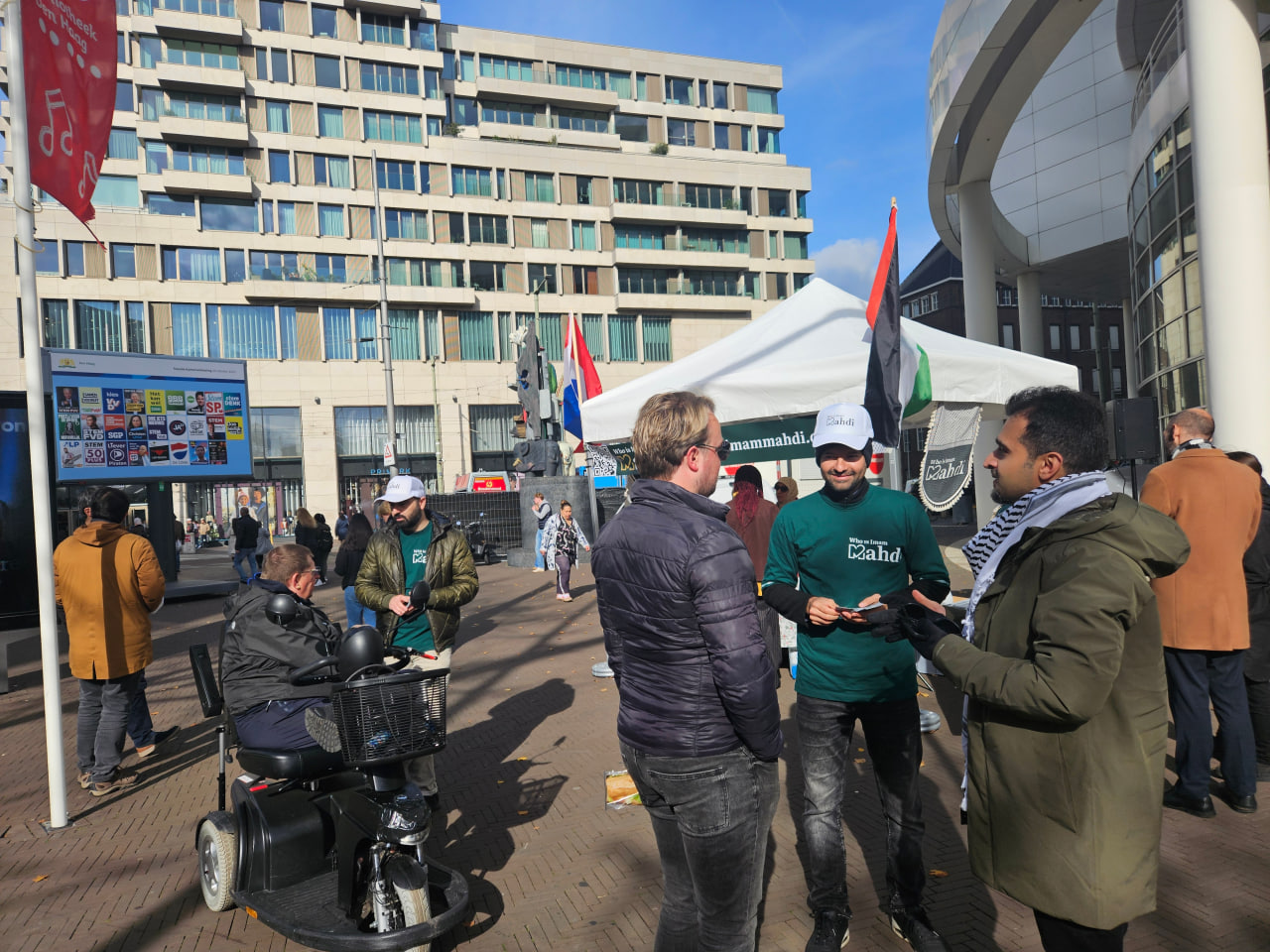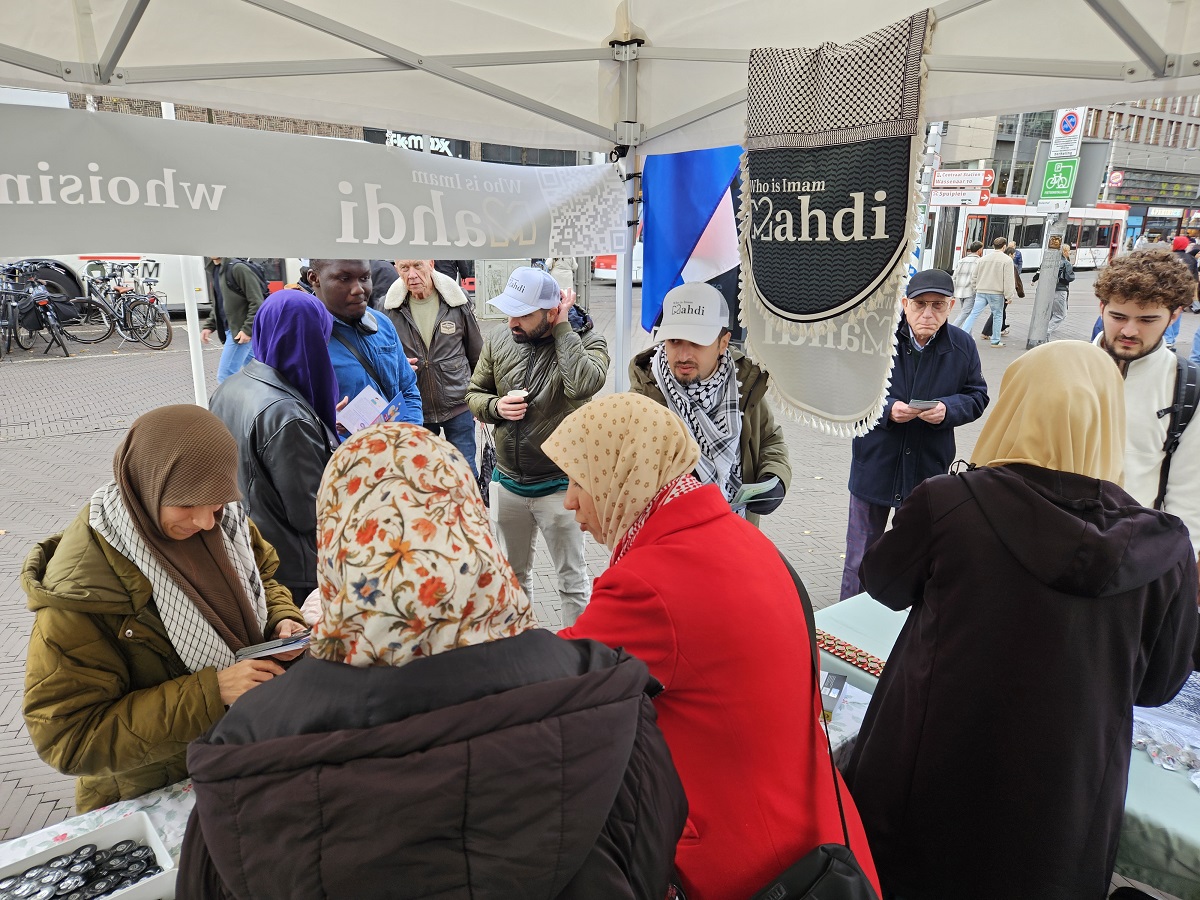
I spoke with a man who was a human rights activist. His work involved monitoring developments in the Netherlands to determine whether they constituted violations of human rights and then pursuing those cases in court. He said, “When I prepare texts for court, I use passages from the Qur’an, the Bible, or other sacred books.”
Because of this, he was someone who had studied religious texts. He asked me, “What are you doing here today?”
I replied, “We are talking about the future—about where humanity is ultimately heading, and whether we can truly achieve justice and peace in the world.”
He said, “In my opinion, we cannot.” He explained that natural resources are not distributed equally across the world, and because of this imbalance, countries attack one another and colonize others in order to exploit those resources. Therefore, he believed this problem is fundamentally unsolvable.
I responded, “For you, resources are the main issue. For someone else, it is money; for another, ideology. Everyone has a different analysis of the problem. But ultimately, what then? Should we not at least try to find a path toward an ideal society, an ideal condition, and an ideal future?”
I continued: “Just as in the era of kings and queens no one believed that a day would come when ordinary people would vote, candidates would campaign, and rulers would make promises—if we had said such things back then, people would have laughed at us. Today, if we speak about such a future, it may seem unbelievable as well. But just as people struggled and eventually reached democracy, we too can strive and reach that future.”
He said, “That is an interesting idea—but the entire world would have to want it.”
I added, “Generally, all major global movements have shared three common elements: a shared goal, collective empathy, and leadership. This empathy has sometimes begun with a single individual rising up—like Nelson Mandela—or through collective uprising, such as the civil rights movement of Black Americans seeking equal citizenship. When these three elements exist, a goal can be achieved.”
I gave the example of Palestine: “Today, people around the world empathize with Palestine and want the land returned to its people. Yet because there is no leadership to carry this cause forward, despite widespread public desire for justice and an end to civilian deaths, nothing changes—and innocent people continue to be killed.”
He responded, “But even a good leader can be flawed. Leaders have children; they forgive their own children’s mistakes but condemn others for the same actions. A leader cannot be truly just. And even if one is just, when their term ends and another leader comes, new principles are introduced and the path changes.”
I replied, “I can introduce you to a school of thought whose leaders have all followed the same path, consistently, up to the present—and this is historically documented.”
He said, “Alright, let’s assume we find a good leader. What about the people? The people must also participate. A good leader alone is not enough.”
I answered, “You are absolutely right. Society must also be capable of standing up and participating. I know of such a society—one that is constantly practicing readiness and responsibility.”
I then gave the example of Arbaeen. At first, he thought I was referring to Hajj. I said, “No, this is not Hajj; it is something else.” I explained that every year, more than two million people from over a hundred countries gather and live together for about ten days. I described the lifestyle of equality: volunteers serve everyone selflessly, local residents open their homes and sleep outside so pilgrims can rest inside, and the participants themselves strive to make life easier for one another.
I said, “If you see this society gathering in this way, it is because they are united under the leadership of a man named Husayn—whose model of leadership was unwavering resistance to oppression.” He never accepted the logic of tolerating one tyrant in hopes that the next ruler might be better. He rejected all forms of injustice entirely. He opposed the enslavement of women, the killing of children, the imprisonment of civilians, and the murder of innocent people. He stood firmly against tyrannical rule.
Because of this leadership model, societies such as Iran, Lebanon, and other followers respond quickly and decisively to Zionist aggression. This is what real resistance looks like.
At this point, he became visibly interested. Then he asked, “You say we need a leader—but aren’t you Muslim? You have a holy book. Can’t you just read it, gain knowledge from it, and manage yourselves? Why do you need a leader?”
I explained, “New events constantly occur, and major scientific and societal transformations take place. Do you really think we can handle all of this alone? That leader helps us because he is connected to the Creator. He helps us understand how the Book we already have can guide us in addressing new and unprecedented issues—whether scientific or otherwise—and how to reinterpret and apply it to solve contemporary problems.”
He paused, thought deeply, and said, “That is also an interesting idea.”
Then he added, “Let me share my personal belief with you.”
I said, “Please do.”
He continued: “I believe we must all return to nature. That means first loving ourselves, and then loving nature. When we are thirsty, water comes from nature; when we are hungry, food comes from nature. If everyone loves themselves and nature and reconnects with it, their problems will be solved, their needs fulfilled, and wars will cease.”
I asked him, “Is it possible to force someone to love something?”
He replied, “No, that’s not possible.”
I said, “Then how do you intend to make people love nature? Your idea doesn’t work.”
He responded, “That’s why I believe a day of judgment will come—on that day, those who loved themselves and nature and did good will be allowed to remain on Earth and benefit from it. The rest will be eliminated.”
I told him, “This is very similar to a verse in the Qur’an where God says that He will cause the earth to be inherited by the righteous servants. We already have this concept in our scripture—but your argument is contradictory. You say people cannot be forced to love something, yet you want to judge them based on whether they loved nature or not.”
He replied, “I think it works, and I don’t see a problem with it. I am even writing a book on this.”
I said, “Alright. I wish you success. In my view, your ideas are contradictory—but I respect your belief.”
He responded, “And I found your perspective interesting as well.”
He took the brochures with him to read as he left.