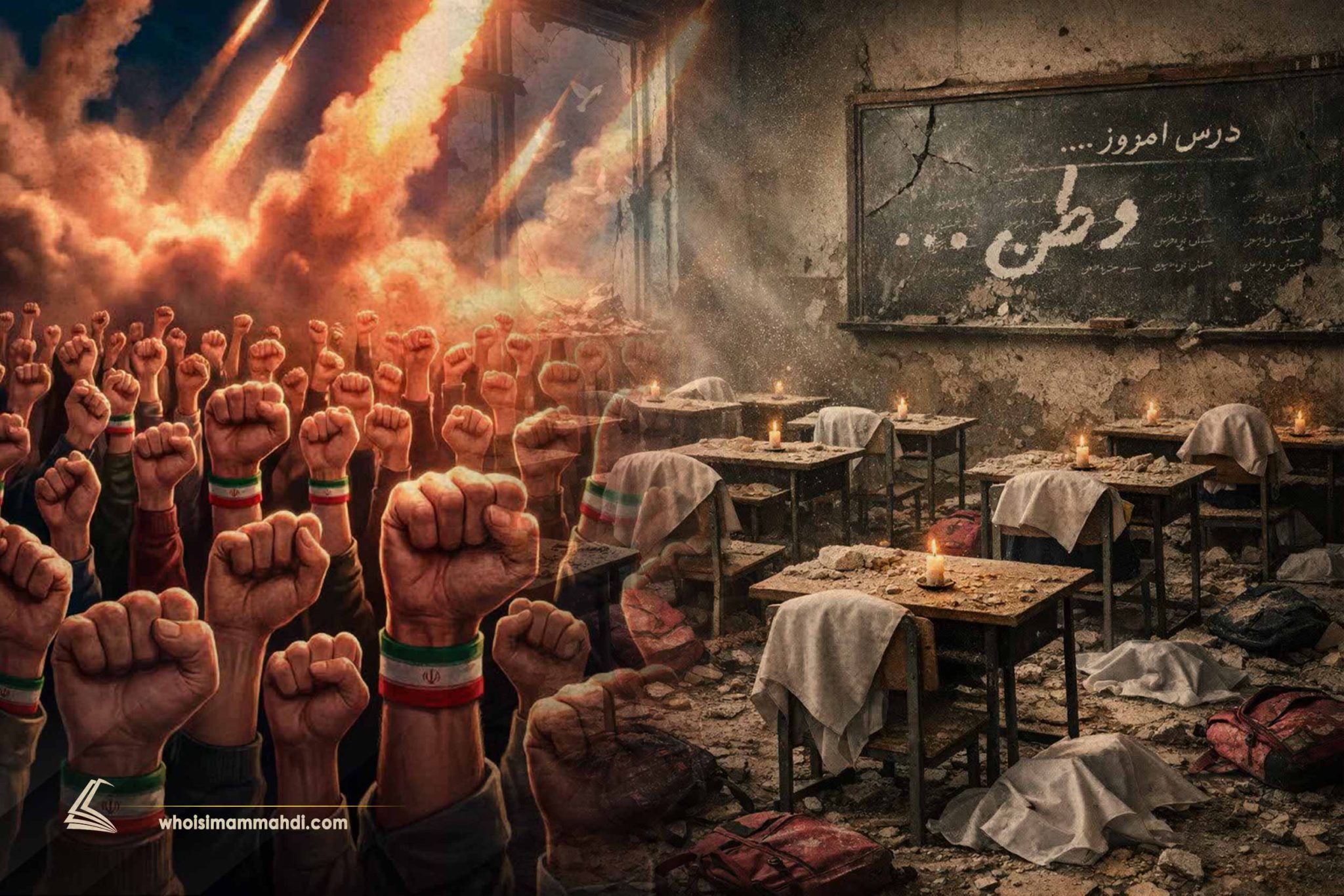
A Divine Trial on the Threshold of a New Dawn Amid the End-Times War in Iran
The world has always been an arena for the eternal struggle between two opposing poles. Today, once again, the Islamic nation of Iran stands on the threshold of a new dawn, facing a major test. The confrontation between the Islamic Republic of Iran and the United States and Israel during the holy month of Ramadan 1447 transcends a mere political or military conflict. This complex End-Times war in Iran is a divine trial—a test in which understanding the true nature of this conflict and the essence of the enemies’ evil is vital, not only for choosing the right path but also for protecting identity and traversing the divine path until the advent of the Savior of humanity. The outcome of this test will determine the destiny of the New Islamic Civilization—a proposed model of society based on Islamic principles, emphasizing justice, spirituality, science, and morality, in contrast to prevailing Western secular models (Khamenei, “The Second Phase”). This article seeks to explain the importance of this great divine trial for Iran and the entire world. Furthermore, this article regards the monotheistic perspective as a crucial key to overcoming this trial, thereby paving the way for the establishment of an Islamic civilization.
Monotheism as a Worldview, Not Merely a Belief
In the discourse of the Islamic Revolution, monotheism (Tawhid) is not presented as a private belief or a doctrinal formula. Rather, it is framed as a comprehensive worldview that shapes one’s understanding of reality, causality, power, and history (Motahhari 33-34).
The monotheistic worldview asserts that God is the sole source of existence, power, and effectiveness. As the Quran states: “To Allah belongs the sovereignty of the heavens and the earth” (3:189). This has practical implications: material causes (weapons, wealth, military alliances) are not denied, but they are not treated as the only or most decisive causes. They are understood as instruments whose ultimate efficacy depends on divine will.
This perspective is famously encapsulated in the Quranic verse, “You did not throw when you threw, but Allah threw” (8:17). The verse refers to the Battle of Badr, where Prophet Muhammad’s act of throwing pebbles at enemy forces was attributed not to his own power but to divine agency (Makarem Shirazi). In the context of the End-Times war in Iran, this verse is invoked to argue that even advanced weaponry and military technology are merely tools in the hands of divine will.
What we are witnessing in this conflict is not merely a clash of military and media powers but a struggle between two worldviews: the monotheistic worldview, which recognizes God as the only source of power, and the materialistic worldview, which considers itself the source.
Divine Testing in the Quran: A Universal Law of Creation
The Quran presents the concept of divine testing as a universal law of creation. God tests human beings to distinguish the sincere from the insincere, the patient from the impatient, and the faithful from the hypocrites. The Quran directly asks: “Do the people think that they will be left to say, ‘We believe,’ and they will not be tested?” (29:2). In another verse, God specifies the nature of these trials: “We will surely test you with a measure of fear and hunger and a loss of wealth, lives, and fruits; and give good news to the patient.” (2:155).
The purpose of testing, as stated elsewhere, is not for God to gain knowledge (for He already knows all), but for human potential to be actualized: “Did you think that you would enter Heaven without Allah testing those of you who fought hard (In His Cause) and remained steadfast?” (Quran 3:142).
Regarding the End-Times war in Iran, the current confrontation is interpreted as one such test—perhaps the final and most severe test before the advent of the Savior.
The New Islamic Civilization: Justice, Spirituality, Ethics, science
The New Islamic Civilization is a central concept in contemporary Iranian political discourse. The term has been elaborated in the “Second Step of the Revolution” (2019) by Ayatollah Khamenei (Khamenei, “The Second Phase”). The New Islamic Civilization can be defined as a proposed model of society based on Islamic principles, emphasizing justice, spirituality, science, and ethics (Rahbaran et al. 387-88), in contrast to prevailing Western secular models. It seeks to integrate material progress with spiritual development and to establish a global order based on divine law rather than secular liberal values (Khamenei, “The Second Phase”).
Several key principles define this civilization. First, tawhid-centric worldview means that God is the ultimate source of value, law, and legitimacy. Second, justice serves as the primary objective in social, economic, and political spheres. Third, science and technology are embraced but guided by ethical and spiritual values. Fourth, ethics and spirituality constitute essential dimensions of civilization.
But a civilization built on these principles cannot be declared; it must be demonstrated. The End-Times war in Iran is the arena of demonstration. Through steadfastness, faith, and sacrifice, the nation proves that it is not merely speaking of justice and tawhid but living them. And in that proof, the nation becomes the standard-bearer of the New Islamic Civilization.
The Inevitability of Direct Conflict: Historical and Theological Perspectives
The inevitability of direct conflict with oppressive powers stems from both historical precedent and theological reasoning. Imam Khomeini is frequently quoted as stating that the path of the Islamic Revolution is a permanent struggle (Khomeini 5: 471). This statement is grounded in the understanding that the struggle between truth and falsehood is not a temporary condition but an enduring feature of human history. Every prophet, from Noah to Muhammad (Peace be upon them), faced opposition from the arrogant powers of their time (Quran 25:31). The Islamic Revolution is framed as the continuation of this prophetic history—indeed, as its final stage before the advent of the Savior.
The logic of inevitability follows from the nature of oppressive systems. According to this discourse, when oppressive powers sense their final collapse, they do not retreat peacefully. Instead, they initiate direct confrontation in a desperate attempt to survive.
This perspective frequently invokes Karbala—the battlefield where Imam Hussain, the grandson of Prophet Muhammad (Peace be upon him and his family), was martyred in 680 CE along with his small band of companions. Imam Hussain (Peace be upon him), knowing that he would be killed, chose to confront the tyrannical Umayyad army rather than pledge allegiance to the unjust ruler Yazid (al-Tabari 5: 342-344). Most Muslims of the time remained in their homes, praying and fasting but avoiding political engagement. Only a few joined him in Karbala.
Iran is framed as having chosen the “history of Karbala” while other nations (including many Muslim countries) have chosen the “animal-like life” of political quietism (Khamenei, “In the Path”). The choice is not about victory or defeat in material terms but about being present in the history that leads to divine salvation. This framing transforms martyrdom from a tragedy into a sign of honor. Martyrdom is not an end but the peak of perfection. The loss of leaders and commanders, rather than causing despair, is reinterpreted as proof of the nation’s worthiness.
The current war is understood not as a conventional military confrontation but as a hybrid war involving military, economic, media, and psychological dimensions (Khamenei, “The Fall”). In this context, sanctions, assassinations, cyberattacks, and media propaganda are not isolated events, but are understood as fundamental components of this multi-faceted conflict.
This perspective reshapes how the assassination of military commanders and nuclear scientists is perceived. Rather than seeing these as tactical successes for the enemy, they are interpreted as signs of failure in other arenas—proof that economic sanctions and military threats have failed to produce surrender. By reframing these losses as evidence of enemy desperation, the narrative serves to neutralize their psychological impact. Instead of damaging morale, the loss of leaders is transformed into an opportunity for the nation to demonstrate its steadfastness, thereby robbing the assassinations of their intended effect.
The Monotheistic Test: Components and Functions
The monotheistic test measures reliance on God and belief in divine victory. Today, the Iranian nation is tested: Will it falter before the enemy’s apparent might, or will it make resistance its foremost endeavor by relying on God’s eternal power? Based on the sources analyzed, the monotheistic test with respect to the End-Times war in Iran consists of several components:
One component concerns reliance on God (tawakkul) versus reliance on material means. This asks whether the nation relies on its own material capabilities or on divine power. This does not mean rejecting material preparation. Rather, it means recognizing that material means are insufficient without divine support and that divine support can overcome material deficiencies (Rahbaran et al. 387). As the Quran states: “And whoever puts his trust in Allah, He will suffice him” (65:3).
Another component involves steadfastness (istiqamah) versus despair and surrender. Here, the nation is tested on whether it remains steadfast in the face of hardships: military losses, economic pressure, and psychological warfare. The example of Imam Khomeini during the Iran-Iraq War—remaining calm and preparing for prayer even after the fall of Khorramshahr—is presented as the model of steadfastness (Khamenei, “A Major Benefit”).
A further component examines faith in divine promise versus fear of the enemy’s power. The test measures whether the nation believes in the divine promise that “the righteous shall inherit the earth” (Quran 21:105) or whether it succumbs to fear of the enemy’s apparent power. The material and military power of the US and Israel, though seemingly immense, is understood as unstable and temporary.
The final component considers prioritizing duty versus prioritizing comfort. This dimension examines whether the nation prioritizes its duty to support God’s religion over personal and national comfort. Unlike prayer and fasting (which can be compensated later), there is no compensation for abandoning jihad (striving in the way of God).
Beyond its theological content, the monotheistic test serves several social and political functions:
-War produces death, destruction, and suffering, but the belief in divine testing transforms these losses from meaningless tragedies into meaningful sacrifices. As the Quran states, those who die in the cause of Allah are not dead but alive with their Lord, receiving provision (3:169). Those who survive and endure thus become active participants in building the new civilization, not passive sufferers.
-External threats can either fragment societies or unite them. By presenting the war as a collective trial for the entire nation, the monotheistic test encourages unity. In the face of foreign enemies who have come to attack the Ummah (Global Muslim Community), internal differences lose their priority and are set aside for the shared goal of passing the divine test.
-A powerful source of motivation also emerges from this perspective. Soldiers and citizens are not fighting merely for territory or political objectives; rather, they are participating in a divinely ordained mission. This understanding can sustain morale even when material conditions are difficult.
-When war is understood as a divine test, seeking to end it by any means—including compromise or surrender—ceases to be a pragmatic option and becomes a failure of the test itself. As a result, any diplomatic solution that requires concessions to the enemy is treated as illegitimate.
The Days of Decree: Civilizational Choice at a Historical Crossroads
The “days of decree” are not merely historical events; they are recurring moments of civilizational choice. This section explores how the Quranic concept of Ayyam Allah applies to the current End-Times war in Iran, where Iran’s steadfastness will determine whether it proves worthy of establishing the New Islamic Civilization.
The Quran refers to “days of God” during which significant events occur: “And remind them of the days of Allah” (14:5). These are moments when divine intervention is manifest, when nations are tested, and when history takes decisive turns.
The concept of “days of decree” (ayyam al-qadr) extends this Quranic idea. While “nights of decree” (layali al-qadr) occur annually and determine events for the coming year, “days of decree” are larger in scale. They determine the honor or humiliation of nations, their path forward, and the leadership they deserve.
After Moses returned from Mount Sinai, he found that many of the Children of Israel had begun worshipping a golden calf. Moses commanded the believers to confront those who had fallen into idolatry. Only the Levites (the priestly tribe) and a small group remained firm. After the rebellion subsided, God forgave the Children of Israel but declared that only the Levites—those who had passed the test—were permitted to serve in the sanctuary (The Bible, Exodus 32:26-29).
Later, when the Children of Israel were commanded to enter the Promised Land, they disobeyed again. As a result, they wandered the earth for forty years. This example illustrates the principle that nations are tested in their days of decree, and the outcome determines their subsequent history.
In Islamic history, the period following the assassination of Imam Ali (Peace be upon him) and the brief caliphate of Imam Hassan (Peace be upon him) is presented as a day of destiny. When the community showed weakness in supporting the rightful leaders, they ended up under the tyranny of Yazid ibn Mu’awiyah, the Umayyad ruler whose forces martyred Imam Hussain (Peace be upon him) at Karbala (Namaee 65-74). This historical outcome is presented as a direct consequence of the community’s failure to pass the test.
According to this view, the current era serves as another day of decree. The confrontation between Iran (representing the monotheistic worldview) and the US/Israel (representing materialistic, arrogant power) is presented as the moment when two civilizational models face each other.
The materialistic civilization, characterized by secularism, consumerism, and the concentration of wealth and power, is described as “declining.” The monotheism-centric civilization, characterized by justice, spirituality, and divine law, is described as being at the critical moment of its birth.
The divine test of this hour will determine whether the present generation proves worthy of the new civilization. By choosing how and where they stand, they will determine their own destiny and the destiny of future generations.
Conclusion: The Monotheistic Path to the New Islamic Civilization
In today’s world, wherever global arrogance exists, security takes on a “West-centered” hue. Countries like Japan and South Korea have achieved economic and technological success at the cost of full strategic independence, as their deep security dependence on the United States has significantly limited their sovereignty (Smith 45-67). In contrast, there is a deeper path: monotheism-centric civilization. This is what the Islamic Republic of Iran is building—a civilization rooted in religious law and ethics, guiding society toward perfection and the advent of humanity’s Savior (Khamenei, “The Second Phase”).
This monotheistic civilization embodies the “real history” to which Imam Khomeini called believers. He restored true meaning to history—a history that began with creation, continued through the prophets, and will reach its peak with the advent of the Savior.
During the Islamic Revolution, the people’s resilience proved they were worthy of a leader like Imam Khomeini. They overcame the fear of the Shah’s regime and Saddam’s attack, backed by world powers. This steadfastness was a practical manifestation of monotheism and heralded a new civilization where science, spirituality, and justice prepare the ground for the advent of the Promised Savior.
The people of Iran recognize these days as a turning point. Their leaders have taught them to rise when their homeland faces a crisis. The history of the righteous records their resistance as the starting point for divine help. Now is the time to prove loyalty to the divine covenant. With steadfastness derived from this real history—with the monotheistic perspective—the faithful will become the true inheritors of the earth, God willing. As the Quran states: “O you who have faith! Be patient, stand firm, and close [your] ranks, and be wary of Allah so that you may be felicitous” (3:200).
Works Cited
Al-Tabari, Muhammad ibn Jarir. The History of al-Tabari (Tarikh al-Rusul wa al-Muluk). Translated by various scholars, State University of New York Press, 1985-2007.
The Bible. New International Version, Zondervan, 2011.
Khamenei, Ali. “The Fall of the International Legal Order: The Last Chapter of the Arrogant Front’s History.” Khamenei.ir, 2024, english.khamenei.ir/news/12068/The-fall-of-the-international-legal-order-The-last-chapter-of. Accessed 24 May 2026.
Khamenei, Ali. “In the Path to the New Islamic Civilization.” Khamenei.ir, 2020, english.khamenei.ir/news/8333/In-the-path-to-the-New-Islamic-Civilization. Accessed 24 May 2026.
Khamenei, Ali. “A Major Benefit Brought by Imam Khomeini Was His Familiarizing People with Concept of Resistance.” Khamenei.ir, 3 June 2022, english.khamenei.ir/news/9027/A-major-benefit-brought-by-Imam-Khomeini-was-his-familiarizing. Accessed 24 May 2026.
Khamenei, Ali. “The Second Phase of the Revolution Statement Addressed to the Iranian Nation.” Khamenei.ir, 12 Feb. 2019, english.khamenei.ir/news/6415/The-Second-Phase-of-the-Revolution-Statement-addressed-to-the. Accessed 27 May 2026.
Khomeini, Ruhollah. Sahifeh-ye-Imam: An Anthology of Imam Khomeini’s Speeches, Messages, Interviews, and Decrees. Vol. 5, Institute for Compilation and Publication of Imam Khomeini’s Works, 1999.
Makarem Shirazi, Naser. “You Did Not Throw When You Threw! (Verse No. 17).” Tafsir Nemooneh, vol. 7, old.makarem.ir/compilation/Reader.aspx?lid=0&mid=31646&catid=0&pid=61926. Accessed 29 May 2026.
Motahhari, Morteza. Society and History: Islamic Propagation Organization, Tehran, 1985.
Namaee, Ahmad. Caliphate and Imamate. Islamic Research Foundation Astan-e Quds Razavi, 2014.
The Quran. Translated by Ali Quli Qarai and Marmaduke Pickthall, Wiki Ahlolbait, wiki.ahlolbait.com. Accessed 27 May 2026.
Rahbaran, Homayon, et al. “Components of Modern Islamic Civilization in the Thought of Ayatollah Khamenei.” Periódico do Núcleo de Estudos e Pesquisas sobre Gênero e Direito, vol. 9, no. 02, 2020, pp. 380-88.
Smith, John. “Limited Sovereignty in the Indo-Pacific: Japan, South Korea, and the Price of Security Alliances.” The Rest Journal, vol. 15, no. 2, 2025, pp. 45-67.