The Civilization-Building Role of Prophet Abraham (Peace Be upon Him) in the Historical Trajectory of Divine Guidance
Within the epistemic framework of the Holy Quran, human history is not viewed as an arbitrary, fragmented sequence of disconnected events or secular power struggles. Instead, it is understood as a profoundly purposeful, divinely guided developmental movement. In this teleological progression, divine prophets function as the primary drivers of humanity’s spiritual, intellectual, and social development.
Among these monumental figures, Prophet Abraham (Peace be upon him) occupies a uniquely central, axial position. The Quranic discourse explicitly elevates him beyond the traditional boundaries of regional prophethood, designating him with the comprehensive station of Imamate (universal leadership), as stated in the verse: “He said, ‘I am making you the Imam of mankind’” (Quran 2:124).
In classical Quranic exegesis, particularly in Al-Mizan fi Tafsir al-Quran by Allamah Tabataba’i (2:124), the station of Imamate signifies an all-encompassing, cross-temporal guidance that governs the historical, spiritual, and social dimensions of humanity. This position surpasses the mere delivery of divine revelation (iblagh al-risalah); it denotes the actual realization, execution, and structural management of a divine civilization. Consequently, Prophet Abraham is not a localized reformer acting within a specific historical epoch. He is the architect of an enduring civilizational current rooted in absolute monotheism (tawhid), cosmic servitude (ubudiyyah), and the reorganization of human society around primordial divine values.
According to Quranic axiology, all divinely appointed messengers belong to a singular, unified lineage, with each prophet serving as a vital link in the continuous chain of divine pedagogy. This historical continuity implies that the prophetic missions, taken collectively, constitute a long-term cosmic project aimed at preparing humanity for the ultimate realization of an ideal global society.
Within this structural framework, the appearance of Prophet Abraham marks a critical transition. With his mission, the monotheistic movement evolved from localized, protective declarations of faith into an organized, socially institutionalized, and historically conscious civilizational force. Thus, the Quran frequently references the specific socio-religious framework known as the “Creed of Abraham” (Millat Ibrahim), instructing Prophet Muhammad (Peace be upon him and his family) to operate as the direct historical continuation of this very path: “Then We revealed to you: ‘Follow the creed of Abraham, a Hanif’” (Quran 16:123). The historical trajectory initiated by Abraham laid the structural foundations upon which the final Islamic dispensation was built. In the wider horizon of historical teleology, this current is destined to culminate in a global civilization defined by universal justice and monotheism.
Ontological Authenticity of Monotheism as the Axis of Civilizational Theory
To understand the civilizational mechanics of the Abrahamic model, one must analyze the absolute primacy of monotheism as the foundational infrastructure of any genuine human civilization. In Quranic philosophy, a civilization is not defined merely by its material output, political centralization, economic surplus, or technological infrastructure. Rather, material systems are understood as outward expressions of an underlying metaphysical, normative worldview that defines the human relationship with absolute reality.
Every society organizes itself around a distinct conception of existence, the human being, and the purpose of life. If this foundational relationship is not anchored in monotheism, even the most advanced social and material structures will eventually degenerate into systemic oppression and alienation, manifesting as either explicit or implicit polytheism (shirk). For this reason, the Quran synthesizes the shared core of all prophetic interventions into a single, socio-metaphysical axiom: “Certainly We raised an apostle in every nation: ‘Worship Allah, and keep away from the Rebel’” (Quran 16:36).
This structural directive demonstrates that the prophetic call is never confined to a passive, abstract theological assertion regarding the existence of a singular Creator. It is an assertive blueprint designed to restructure individual and collective human life around divine sovereignty. Crucially, the command to establish absolute divine servitude is indivisibly coupled with the radical negation of taghut—which encompasses any self-absorbed, tyrannical, or socio-political power that operates independent of divine law.
This structural framework illuminates the profound historical disruption caused by Prophet Abraham. The society in which he operated was not merely practicing localized polytheistic rituals. It was embedded in a highly sophisticated, totalizing system of institutionalized polytheism. In that ancient near-eastern context, cultural mythologies, cosmic astrological symbols, and state political authorities were organized into an integrated hierarchy of absolute domination, where rulers like Nimrod claimed ontological lordship (rububiyyah).
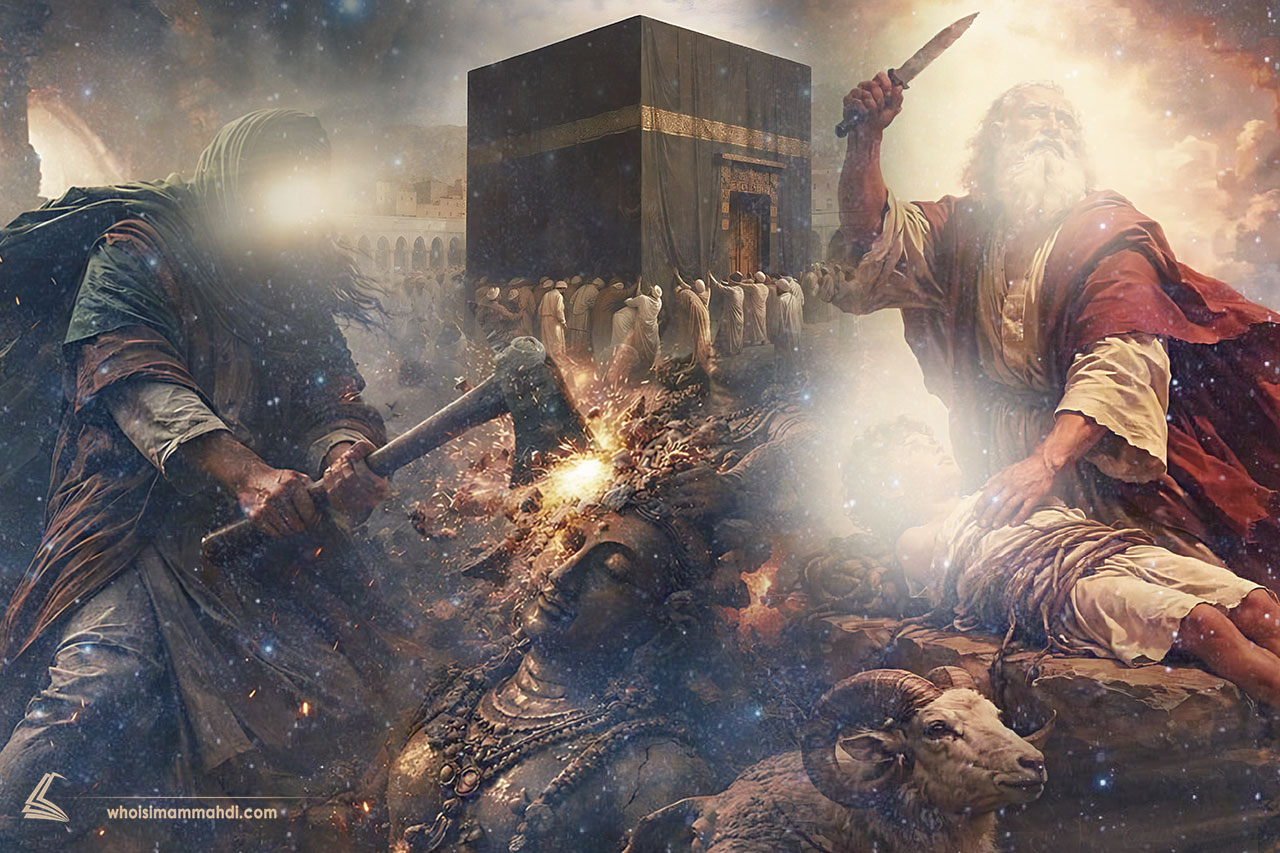
Abraham systematically dismantled this cognitive and political hegemony. His iconic, symbolic act of destroying the physical idols of the state pantheon—recorded with deliberate socio-psychological detail in the Quran—was far from an impulsive act of protest: “So he broke them into pieces—all except the biggest of them, so that they might come back to it” (Quran 21:58). This action was a calculated deconstruction of an entire epistemic paradigm, designed to shock the collective consciousness of his society into intellectual liberation. The analytical inquiry he posed to his contemporaries directly challenged the foundational rationality of their socio-political subordination: “He said, ‘Do you then worship, besides Allah, that which cannot cause you any benefit or harm?’” (Quran 21:66). This inquiry served as a universal summons to rational, critical reflection regarding the source of social legitimacy and spiritual authority. It sought to liberate human consciousness from the stagnation of blind historical custom and unexamined traditions, redirecting humanity toward an open, monotheistic contemplation of cosmic reality.
From this philosophical perspective, polytheism is categorized not merely as an error in private theological judgment, but as a profound disruption of the human being’s ontological relationship with the Source of Existence. When this primal relationship is distorted, the societal value system and its institutional structures lose their moral equilibrium, creating an environment ripe for the rise of oppressive, self-deified political powers. The Abrahamic intervention was a foundational correction of this ontological relationship, repositioning the human being within the cosmic order to ensure authentic freedom.
Therefore, a monotheistic civilization is defined first and foremost by the radical liberation of human existence from external degradation. In documenting the historic intellectual conflict between Prophet Abraham and the tyrannical ruler Nimrod, the Quran notes: “Have you not regarded him who argued with Abraham about his Lord, because Allah had given him kingdom?” (Quran 2:258). The core conflict here centered directly on the concept of rububiyyah—the absolute right to govern, legislate, and determine the existential destiny of humanity. In the paradigm of monotheism, absolute lordship belongs exclusively to the Creator; any earthly power asserting absolute, autonomous sovereignty independent of divine justice constitutes an illegitimate autocracy (taghut).
This principle is forcefully echoed by Imam Ali (Peace be upon him) in Nahj al-Balagha: “Do not be a slave to another human being, for Allah has created you free” (Letter 31). This aphorism highlights that the core of monotheistic civilization is the absolute emancipation of the human being from all forms of non-divine subjugation. Within this system, intrinsic human dignity—metaphysically declared in the Quran: “Certainly We have honored the Children of Adam” (Quran 17:70)—can only be realized through monotheism. Conversely, polytheism acts as an existential fragmentation, fracturing the inner unity of human consciousness and social solidarity.
In the school of transcendent philosophy (al-Hikmah al-Muta’aliyah), reality is understood as a singular, graded unity (tashkik al-wujud), wherein all existential diversity ultimately traces back to a singular, absolute source (Rizvi 54). Translated into the social realm, this ontological unity dictates that human society can only achieve sustainable cohesion, peace, and justice when it harmonizes with this absolute singular axis. Without a transcendent moral center, competing social, economic, and political factions inevitably collapse into systemic conflict, wherein raw material power replaces objective truth (Nasr 112).
This philosophical reality is thoroughly developed by Al-Farabi in his classic text Ara’ Ahl al-Madina al-Fadila (The Principles of the Opinions of the Citizens of the Virtuous City). Al-Farabi argues that the virtuous, ideal city cannot manifest unless the collective life of its citizens is structured around deep knowledge of the First Cause (Al-Farabi, chs. 1, 15). This philosophical analysis aligns perfectly with the Quranic account of Prophet Abraham’s mission. Abraham prioritized reforming the cognitive, metaphysical foundations of his society, knowing that an equitable, durable socio-political order could not exist on a corrupted intellectual foundation.
The Quran underscores Prophet Abraham’s exceptional civilizational status by identifying his singular personality as an entire civilization in its own right: “Indeed Abraham was a nation, obedient to Allah, a Hanif” (Quran 16:120). Applying the term Ummah (nation/community) to a solitary individual indicates that Abraham systematically embodied the complete structural blueprint of an entire historical current. By redefining humanity’s relationship with the divine and invalidating all forms of false lordship, he established the baseline for a new social order, replacing subjugation to tyrannical states with voluntary servitude to God. His mission represents the birth of a permanent monotheistic revolution designed to restore humanity to fitrah (pure primordial nature): “The origination of Allah according to which He originated mankind” (Quran 30:30).
An authentic human civilization must be built upon this foundational fitrah. When a society’s relationships and institutions are aligned with this divine spark, it naturally fosters genuine liberty, equity, and human dignity. Thus, the primary legacy of Prophet Abraham is the deep institutionalization of monotheism within the intellectual and structural consciousness of history. The Quran constantly characterizes his orientation using the technical term Hanif: “Abraham was neither a Jew nor a Christian. Rather he was a Hanif, a Muslim” (Quran 3:67).
In Quranic terminology, Hanif denotes an active, uncompromising orientation that systematically rejects all cultural deviations, intellectual compromises, and structural forms of polytheism, turning directly toward pure monotheism. From a civilizational standpoint, this absolute monotheism performs an indispensable structural function: It denies any earthly power absolute, autonomous legitimacy, thereby liberating humanity from tyrannical socio-political structures. Consequently, monotheism is far from a detached theological concept; it is the ultimate foundation for social justice, human rights, and systemic ethical order.
The Metaphysics of Solo Proclamation and the Inception of Institutional Monotheism
A critical axiom of historical development within the Quranic metanarrative is that major civilizational transformations do not typically originate from mass social movements or established majorities. Rather, they are initiated by the profound, uncompromising proclamation of a singular individual or an intensely dedicated minority. This structural reality is exemplified in the early life of Abraham: “Indeed Abraham was a nation, obedient to Allah, a Hanif” (Quran 16:120). This remarkable designation confirms that although Abraham stood entirely alone at the inception of his public call, his absolute fidelity to truth, profound internal certainty, and unyielding resistance to institutionalized polytheism gave him the civilizational weight of an entire nation.
In Al-Mizan, Tabataba’i (16:120) clarifies that designating a solitary individual as an Ummah indicates that Abraham personally possessed the complete suite of ethical, cognitive, and spiritual capacities that are normally distributed across an entire healthy society. Operating in an environment thoroughly saturated by polytheistic state mechanisms, he single-handedly bore the responsibility of the monotheistic vision. He confronted established socio-political frameworks without any worldly allies, establishing a fresh historical trajectory through sheer spiritual resilience (Al-Razi 16:120).
This principle of individual agency sparking civilizational change is emphasized throughout the Quranic narrative. Reflecting on the state’s reaction to his early iconoclastic activities, the text notes: “They said, ‘We heard a youth mention them, who is called Abraham’” (Quran 21:60). This passage highlights the immense structural asymmetry at the start of his mission: a solitary youth challenging an ancient, deeply entrenched civilization. Yet, this localized, individual stand evolved into the global monotheistic current that shaped subsequent world history. The Quran explicitly generalizes this operational dynamic, commanding humanity to break free from collective compliance and pursue individual intellectual awakening: “Say, ‘I give you just a single advice: that you rise up for Allah’s sake, in pairs or singly’” (Quran 34:46).
Classical commentators note that this verse identifies the absolute starting point of all genuine social reformation: an individual’s conscious decision to act purely for transcendent truth, independent of the pressure of the majority. True historical transformation begins within the liberated human conscience before manifesting across broader social structures. This principle is supported by the broader Islamic narrative tradition regarding the mechanics of divine interventions. In Nahj al-Balagha, Imam Ali (Peace be upon him) describes the profound isolation of Prophet Muhammad (Peace be upon him and his family) at the dawn of his mission: “He sent him when the people were straying in confusion… with no household holding the faith except the most minimal” (Sermon 26).
The historical trajectory of Islam—evolving from a persecuted, marginalized minority in Mecca into a massive global civilization—proves that civilizational viability is not determined by initial numerical majorities. It is determined by the internal consistency of its metaphysical paradigm, its commitment to justice, and its resilience under pressure. Abrahamic history confirms that small, dedicated core groups can dismantle corrupt social systems and guide humanity toward enduring truths.
The Micro-Foundations of Civilization: The Sacred Nucleus of the Monotheistic Family
A vital aspect of Abrahamic civilization-building is the deliberate construction of the monotheistic family as the primary institutional cell of the wider social order. In Quranic sociology, a healthy, enduring civilization cannot be built directly upon isolated individuals or vast, centralized state mechanisms. It requires a resilient network of highly functional micro-units—families—specifically structured to cultivate, protect, and transmit core spiritual and ethical values across generations.
Every sustainable historical movement relies on the systematic education (tarbiyah) of a rising generation within an environment of deliberate divine servitude. Abraham understood that his sweeping historical vision could not survive as a temporary, individual intervention; it required cross-generational continuity rooted in a dedicated lineage. Tabataba’i (2:124) emphasizes that the continuity of divine guidance throughout history operates through the deliberate cultivation of a righteous lineage (al-zurriyyah al-salihah), transforming the biological process of succession into a strategic channel for transmitting spiritual leadership (Imamate).
This civilizational strategy is clearly visible in the dialogue following Abraham’s elevation to universal leadership: “He said, ‘I am making you the Imam of mankind.’ He said, ‘And from among my descendants?’ He said, ‘My pledge does not extend to the unjust’” (Quran 2:124). This dialogue demonstrates that Abraham viewed historical leadership as deeply intertwined with rigorous generational transmission and ethical education. The divine response sets an absolute moral standard: Spiritual leadership is not a matter of automatic biological privilege; it is strictly conditional upon absolute adherence to justice and divine law. This principle elevates the family from a mere biological necessity to a strategic arena for fulfilling the divine covenant.
Prophet Abraham’s deep civilizational intent is beautifully captured in his foundational prayers recorded in the Quran: “My Lord! Make me a maintainer of the prayer, and my descendants [as well]” (Quran 14:40). Within Quranic terminology, the establishment of prayer (iqamat al-salat) is never a purely private ritual. It represents the public stabilization of a monotheistic lifestyle within individual and collective life. Abraham’s prayer seeks to institutionalize this practice across his entire future lineage. Commenting on this passage, classical exegetes note that human perfection is achieved when an individual’s commitment to divine truth is successfully sustained throughout their posterity (Al-Razi 14:40). The family thus functions as an essential intergenerational bridge for preserving and passing down monotheistic identity.
The Quran further illustrates this systematic pedagogical focus in its description of Abraham’s final testamentary instructions to his children: “Abraham enjoined this [creed] upon his children, and [so did] Jacob, [saying], ‘My children! Allah has indeed chosen this religion for you; so do not die except as Muslims’” (Quran 2:132). This testament proves that the transmission of faith within the Abrahamic lineage was a highly conscious, deliberate act of spiritual orientation designed to secure the identity of future generations. From the perspective of religious sociology, no civilization can long survive if it fails to robustly reproduce its core values within its primary social structures.
Al-Farabi echoes this insight in his political philosophy, maintaining that a virtuous city cannot endure without organized mechanisms for transferring virtue and knowledge from one generation to the next. The Abrahamic model stands as the primary historical embodiment of this principle. Before attempting to build a large-scale physical empire, Abraham focused on establishing a resilient, value-driven family unit dedicated to absolute monotheism. Even the difficult migration of Hagar and the infant Ishmael to the barren valley of Mecca, along with Abraham’s earnest prayer during that trial, confirms this profound civilizational strategy: “Our Lord! I have settled part of my descendants in a barren valley, by Your sacred House…” (Quran 14:37).
In its earliest phase, Mecca was neither a commercial crossroads nor a strategic political stronghold; it was simply an isolated family sanctuary dedicated to pure monotheism. Through long-term divine planning, this humble domestic nucleus evolved into the global center of the Islamic world and the permanent geographical anchor for monotheistic believers everywhere. History confirms the extraordinary success of this intergenerational strategy, as the major lines of subsequent monotheistic prophethood flowed directly through Abraham’s descendants: “And We gave him Isaac and Jacob… and We ordained among his descendants prophethood and the Book” (Quran 29:27).
Scripture and prophethood—the two foundational pillars of divine civilizational guidance—were systematically anchored within the Abrahamic family line. The appearance of an unbroken chain of monumental prophets, culminating in the final mission of Prophet Muhammad (Peace be upon him and his family), demonstrates that Abraham’s domestic educational project was designed to cultivate a vast spiritual tree whose branches would eventually cover human history. This long-term growth is captured in the classic Quranic metaphor of the “good word” (kalimah tayyibah): “…like a good tree: its roots are steady and its branches are in the sky” (Quran 14:24).
Ultimately, the focus on family within the Abrahamic paradigm is a cornerstone of divine historical planning. By establishing a household grounded in pure monotheism, maintaining strict spiritual discipline, and navigating profound trials of faith (Quran 37:102-107), Abraham provided a universal template showing that a righteous global civilization must always be rooted in a strong, spiritually integrated home.
The Architecture of Global Solidarity: The Kaaba as the Axis of Universal Identity
Among the most lasting structural achievements of the Abrahamic mission was the physical construction of the Kaaba, completed alongside his son Ishmael: “As Abraham raised the foundations of the House with Ishmael…” (Quran 2:127).
Within Islamic civilizational theory, the Kaaba is not understood merely as a localized sanctuary or a conventional house of worship. It functions as the permanent, physical axis for a global monotheistic identity across time and space. Serving as the universal direction of prayer (Qiblah) for all Muslims and the destination for the Hajj pilgrimage, this sacred structure provides a continuous focal point for transnational unity.
The rituals of the Hajj, which directly re-enact the trials and triumphs of the Abrahamic family, constitute the largest regular assembly of human beings on earth, serving as a living demonstration of the Ummah Wahidah (the unified global community). Within these sacred precincts, all superficial distinctions of race, nationality, social status, and economic class are systematically dissolved. Believers gather in identical, simple attire, restoring their shared primordial identity as equal servants of the Creator. Thus, the building of the Kaaba stands as a brilliant civilizational intervention, providing an enduring physical anchor that has preserved a shared identity and sense of brotherhood among monotheists for millennia (al-Faruqi and al-Faruqi 271-279).
Axiological Hierarchy: The Abrahamic Principle of Sacrifice and Societal Sustainability
The capacity for deep self-sacrifice in the pursuit of transcendent justice is an indispensable requirement for the survival of any divinely guided society. In the Quranic metanarrative, monotheism cannot be established through abstract intellectual assent or verbal profession alone. It requires an internal transformation that prepares individuals to surrender their deepest personal attachments, material comforts, and dearest assets whenever they conflict with absolute truth.
Within this educational framework, Abraham’s absolute willingness to sacrifice his son Ishmael represents a defining moment in religious history—an intense existential test designed to demonstrate the ultimate requirements of divine leadership. The Quran records this profound trial with vivid emotional resonance: “When he was old enough to assist in his endeavor, he said, ‘My son! I see in dreams that I am sacrificing you. See what you think.’ He said, ‘Father! Do whatever you have been commanded. If Allah wishes, you will find me to be patient’” (Quran 37:102). This dialogue captures a sublime moment of mutual submission and ultimate devotion, where both father and son align their personal wills completely with the divine decree.
To properly understand this event, one must view it through the lens of divine trial (ibtila). The Quran outlines this fundamental operational principle early in the Abrahamic narrative: “When his Lord tested Abraham with certain words and he fulfilled them” (Quran 2:124). In Al-Mizan, Tabataba’i (2:124) explains that these intense divine trials are not intended to extract new information for the Creator, who possesses all-encompassing knowledge. Rather, they are designed to actualize the latent spiritual capacities of His servants, bringing their devotion into the objective world and preparing them to lead monumental historical movements. The command to sacrifice Ishmael was perhaps the most challenging of these trials, directly confronting the profound bond of parental love—one of the strongest emotional forces in human nature.
From a philosophical standpoint, the core of this trial was not the physical loss of life, but the complete alignment of the human will with divine sovereignty. Once Prophet Abraham and Ishmael demonstrated absolute internal submission, the underlying purpose of the trial was fully achieved: “So when they had both submitted [to Allah’s will], and he had laid him down on his forehead, We called out to him, ‘O Abraham! You have indeed fulfilled your vision!’” (Quran 37:103-105). As classical commentators note, the primary objective was to demonstrate Abraham’s complete freedom from any competing attachment that might distort his absolute devotion to God (Al-Razi 37:102-107). Once this internal clarity was proved, the physical sacrifice was averted, replaced by a monumental legacy: “Then We ransomed him with a great sacrifice, and left for him a good name in posterity” (Quran 37:107-108).
This narrative offers a vital lesson for civilizational theory. The long-term sustainability of a value-based society depends entirely on its citizens’ willingness to prioritize transcendent ethical principles over narrow personal interests. While materialist civilizations are designed primarily to maximize individual consumption and secure immediate resources, a monotheistic society is sustained by a shared readiness to defend truth and justice at any personal cost. The Abrahamic narrative provides a universal model for cultivating individuals who can transcend immediate personal desires to serve the greater good. Notably, Ishmael is not a passive victim in this process; he is an active, conscious participant who embraces the trial with profound patience: “If Allah wishes, you will find me to be patient” (Quran 37:102). This shows that the culture of self-sacrifice was a deeply integrated family value, successfully transmitted through deliberate parental education.
Ultimately, the willingness to sacrifice Ishmael stands as one of the most profound examples of devotion in human history, demonstrating that absolute monotheism must take precedence over even the strongest human affections. A resilient, just social order cannot be built by self-absorbed individuals; it requires people of profound moral character who are ready to make significant sacrifices for the realization of truth. The Quran terms this intense trial “a manifest test” (al-bala’ al-mubin) (Quran 37:106) because it perfectly reveals the depth of a person’s faith and the purity of their devotion. This Abrahamic principle remains a foundational requirement for any civilization that aims to embody divine justice and ensure true human liberation.
Migration as a Strategic Vector for Civilizational Expansion
Within the prophetic tradition, migration serves as a vital strategic mechanism for expanding the monotheistic movement and establishing new cultural spaces. In the Quranic worldview, when the intellectual, political, and social institutions of a society become so corrupted that they completely suppress the expression of faith and justice, migration becomes a necessity: “Indeed, those whom the angels take away while they are wronging themselves, they ask, ‘What state were you in?’ They reply, ‘We were abased in the land.’ They say, ‘Was not Allah’s earth vast enough so that you might migrate in it?’” (Quran 4:97). Elsewhere, it is stated: “Whoever migrates in the way of Allah will find many havens and grace in the earth” (Quran 4:100). It is deployed to preserve the core of the divine message and transfer the center of the movement to a more receptive environment. Abraham’s migrations offer a classic demonstration of this principle: “And he said, ‘Indeed I am migrating toward my Lord. Indeed, He is the All-mighty, the All-wise’” (Quran 29:26).
This declaration shows that his migration was far from a desperate flight from danger; it was a conscious, strategic relocation designed to advance his divine mission. Tabataba’i notes that “migration toward Allah” represents an intentional departure from social environments that stifle spiritual growth and social justice, seeking new territories where monotheistic values can be securely institutionalized (Quran 29:26). This strategic movement led directly to the establishment of major new centers of spiritual and social life. Abraham’s journey through the Levant and his eventual settlement of part of his family in the Hijaz to construct the Kaaba laid the geographical and institutional foundation for a global network of faith: “As Abraham raised the foundations of the House with Ishmael…” (Quran 2:127). Mainstream exegetes agree that this project was much more than the construction of a physical temple. It was the deliberate establishment of a new global center of identity designed to unite diverse human communities across generations (Al-Tabari 2:127; Al-Razi 2:127).
Abraham’s migration functions as an essential strategy for moving the monotheistic movement away from hostile, unyielding social structures into spaces where it can grow without compromise. When an existing political system is thoroughly organized around tyranny, attempting to build a just society within that framework can lead to the neutralization of the movement. Relocating to a new space allows for the uncompromised development of a righteous community. Al-Farabi confirms this sociological reality in his writings, observing that the realization of a virtuous city requires a supportive social and geographical environment free from the corrupting influence of decadent regimes.
This structural pattern was perfectly mirrored in later Islamic history. The migration of Prophet Muhammad (Peace be upon him and his family) from Mecca to Medina stands as the pivotal turning point in the Islamic dispensation, marking the transition from a persecuted minority into a fully functional political and social state structured around Quranic law. The Quran celebrates this transition, elevating the early migrants (Muhajirun) as foundational architects of the faithful community: “The early vanguard of the Emigrants and the Helpers…” (Quran 9:100). Historians of early Islam consistently point out that this migration was not a mere tactical retreat; it was a profound nation-building initiative designed to manifest a new social order based on monotheism (Ibn Hisham 234-235).
Consequently, migration remains a fundamental strategy for the growth of monotheistic civilizations. Abraham’s journeys demonstrate that spreading truth sometimes requires leaving behind oppressive cultural environments to build fresh centers of spiritual life. This approach is an assertive, constructive movement that transfers the divine message to fertile ground. Abraham’s strategic relocations created a resilient network of religious and cultural traditions that shaped the major monotheistic faiths and left an indelible mark on human history.
Teleological Continuity: From the Abrahamic Foundation to the Universal Messianic Realization
The life and achievements of Prophet Abraham cannot be understood as an isolated historical episode. They form an essential foundation within the overarching grand narrative of divine guidance. The Quran presents Abraham as a towering figure whose long-term impact extends far beyond his immediate era or locality, using unique phrasing to underscore his civilizational breadth: “Indeed Abraham was a nation, obedient to Allah, a Hanif” (Quran 16:120). Commentators emphasize that this terminology identifies Abraham as the source of a permanent religious and social heritage that continues to guide subsequent generations (Tabataba’i 16:120).
The Quran establishes a direct, explicit connection between the final Islamic dispensation and this Abrahamic foundation, describing Islam as the authentic restoration of his universal model: “Then We revealed to you: ‘Follow the creed of Abraham, a Hanif’” (Quran 16:123). Believers are explicitly reminded of this profound spiritual and historical lineage: “…the faith of your father, Abraham” (Quran 22:78). These passages demonstrate that the Islamic message, while representing the completion of divine revelation, operates in direct continuity with the monotheistic foundations established by Abraham (Al-Tabari 22:78; Al-Razi 22:78).
This continuity is also evident in the prophetic genealogy. The advent of Prophet Muhammad (Peace be upon him and his family) represents the direct historical answer to the earnest prayers offered by Abraham centuries earlier during the construction of the Kaaba: “Our Lord, raise amongst them an apostle from among them, who will recite to them Your signs…” (Quran 2:129). Classical exegesis widely recognizes the appearance of the Holy Prophet of Islam as the grand fulfillment of this Abrahamic prayer, ensuring the preservation of guidance for future generations (Tabataba’i 2:129; Al-Qurtubi 2:129).
In Islamic tradition, this prophetic sequence is viewed as a single, coordinated historical movement heading toward a clear eschatological goal. All divine messengers have contributed to a shared progressive arc aimed at the ultimate establishment of truth and equity across the earth. A well-known prophetic tradition states: “If there were to remain of this world but a single day, Allah would prolong that day until He sends a man from my family… he will fill the earth with equity and justice as it had been filled with tyranny and oppression” (Abu Dawud 4282). Within this prophetic framework, the future establishment of a global society of justice during the era of the Mahdi (Peace be upon him) represents the ultimate climax of the historical process—a universal realization prepared for by the struggles of all previous prophets.
Seen from this perspective, the life of Prophet Abraham was a vital initial phase in this grand historical design. His bold stand against idolatry, his establishment of universal centers like the Kaaba, and his careful education of a righteous lineage were all focused on creating the necessary structural and intellectual foundations for the ongoing guidance of humanity. His designation as a universal leader (Imam) underscores a cross-temporal influence that continues to shape the spiritual development of the human race: “He said, ‘I am making you the Imam of mankind’” (Quran 2:124). The historical trajectory set in motion by Prophet Abraham represents a continuous, divinely protected process that begins with an individual declaration of faith, develops through successive prophetic dispensations, and will ultimately culminate in a global civilization defined by universal justice, peace, and absolute monotheism (Tabataba’i 2:124).
Conclusion
The academic analysis of the Abrahamic narrative within the Holy Quran reveals that Prophet Abraham was the primary architect of an enduring monotheistic civilizational model. His historical intervention successfully shifted human focus away from localized, polytheistic state systems toward a universal, value-centered society grounded in monotheism. By reforming the foundational worldview of his era, establishing the monotheistic family as a resilient social cell, constructing the Kaaba as a global center of unity, and utilizing strategic migration, Abraham provided a comprehensive blueprint for a healthy human society.
Furthermore, this study demonstrates that the Abrahamic model is not a relic of ancient history, but a dynamic, ongoing current that directly connects to the final Islamic dispensation and extends toward a clear eschatological goal: the global realization of divine justice. The principles he introduced—including absolute spiritual liberty, the rejection of tyrannical authorities, generational moral responsibility, and an unwavering commitment to truth over personal interest—remain the essential prerequisites for building any just, sustainable civilization. Ultimately, the Abrahamic legacy serves as a timeless metaphysical and practical guide, illuminating humanity’s path away from oppression toward a future defined by spiritual dignity, equity, and absolute devotion to the Creator.
Works Cited
Abu Dawud, Sulayman ibn al-Ash’ath al-Sijistani. Sunan Abi Dawud. Translated by Nasiruddin al-Khattab, Darussalam, 2008.
Al-Farabi, Abu Nasr. Ara’ Ahl al-Madina al-Fadila [The Principles of the Opinions of the Citizens of the Virtuous City]. Translated by R. Walzer, Oxford UP, 1985.
Al-Faruqi, Ismail R., and Lois Lamya al-Faruqi. The Cultural Atlas of Islam. Macmillan, 1986.
Al-Qurtubi, Abu ‘Abdullah. Tafsir al-Qurtubi: The General Judgments of the Quran. Translated by Aisha Bewley, Dar al-Taqwa, 2019.
Al-Rāzī, Fakhr al-Dīn Muḥammad. The Great Exegesis: Mafātīḥ al-Ghayb. Translated by Sohaib Saeed, Islamic Texts Society, 2013.
Al-Tabari, Abu Ja’far Muhammad ibn Jarir. Jami’ al-Bayan ‘an Ta’wil Ay al-Quran [The Comprehensive Exposition of the Interpretation of the Verses of the Quran]. Dar Al-Hadith, 2010.
Al-Tabataba’i, Sayyid Muhammad Husayn. Al-Mizan: An Exegesis of the Quran. Vol. 2, translated by Sayyid Saeed Akhtar Rizvi, World Organization for Islamic Services, 1982.
Al-Tabataba’i, Sayyid Muhammad Husayn. Al-Mizan fi Tafsir al-Quran. Mu’assasat al-A’lami lil-Matbu’at, 1997.
Ibn Hisham, Abd al-Malik. The Life of Muhammad. Translated by Alfred Guillaume, Oxford UP, 1955.
Nasr, Seyyed Hossein. Islamic Philosophy from its Origin to the Present: Philosophy in the Land of Prophecy. State U of New York P, 2006.
Nasr, Seyyed Hossein. “The Metaphysical Foundations of the Islamic Order.” Individual and Society in Islam, edited by A. Bouhdiba and M. Ma’ruf al-Dawalibi, UNESCO Publishing, 1998, pp. 43-58.
Qarai, Ali Quli, translator. The Quran: With a Phrase-by-Phrase English Translation. ICAS Press, 2004.
Rizvi, Sajjad H. Mulla Sadra and Metaphysics: Modulation of Being. Routledge, 2009.