
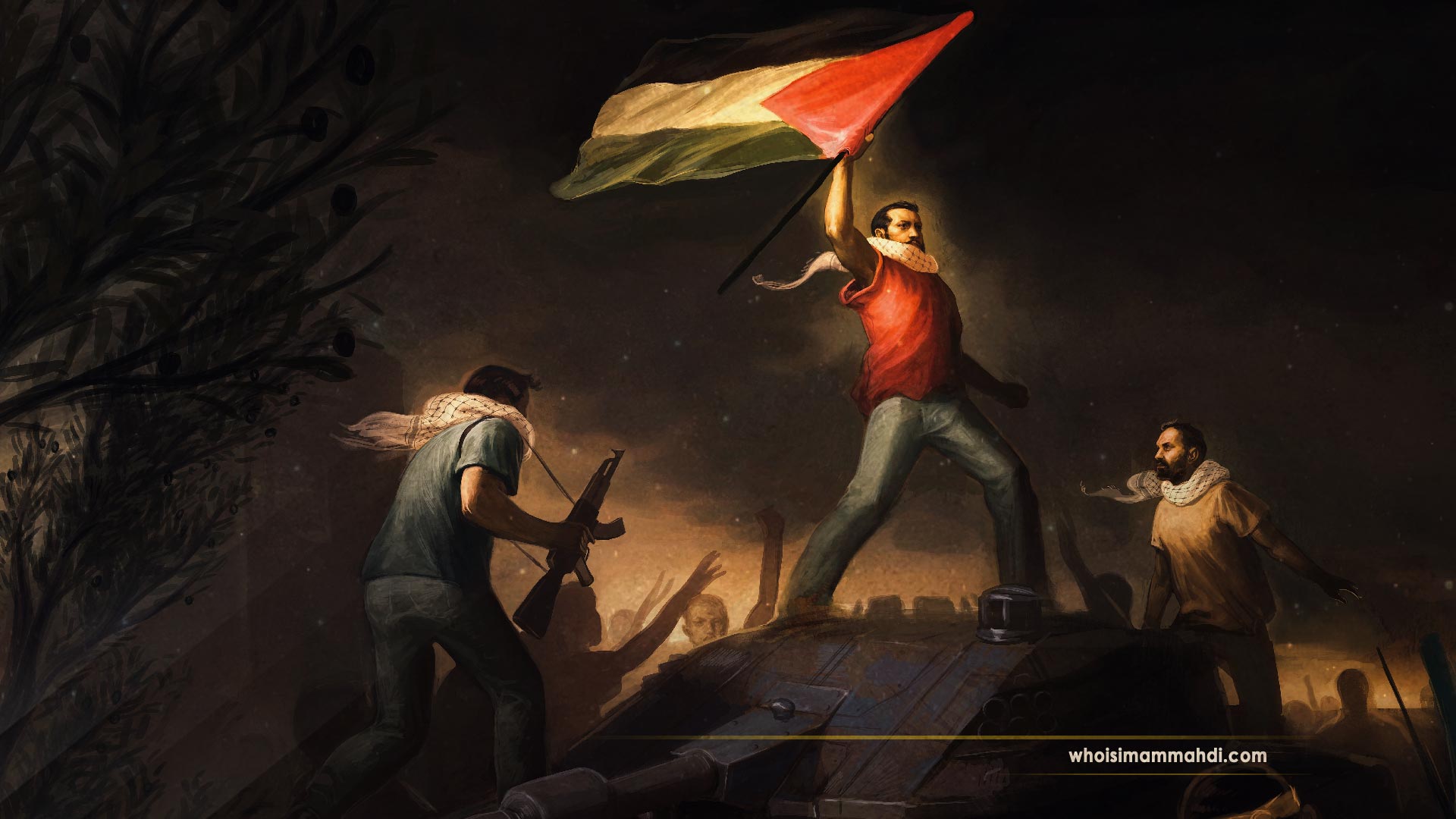
History of the Gaza Strip and Its Key Role in the Battle between the Resistance Front and Zionism
If you follow important global news and events, you have undoubtedly heard the name Gaza Strip multiple times. This small yet tumultuous piece of land in Palestine has always been the focal point of significant developments and events in the Middle East. This coastal strip, located along the eastern Mediterranean Sea, holds a unique position in regional and international equations due to its geographical, historical, and political significance. The history of the Gaza Strip serves as a solid testament to this importance. It is said that the grave of the Prophet Muhammad’s (Peace be upon him) paternal grandfather, “Hashim,” is located in this region [1].
The Gaza Strip is a narrow and elongated area situated on the eastern coast of the Mediterranean, measuring 41 kilometers in length and between 6 to 12 kilometers in width. With a population of approximately 2.3 million people, it has become one of the most densely populated areas in the world [2]. The Gaza Strip is recognized as an autonomous region under the control of the Islamic Resistance Front, “Hamas.” The Strip comprises various sections, with Gaza City, home to about 400,000 residents, being the most significant. Khan Younis and Rafah are also key cities in this region. Since the first spark of popular uprising and the great Intifada of Al-Aqsa Mosque ignited in this area, Gaza has been etched in global political literature as the birthplace of one of the largest resistance movements in the world.
The Kingdom of Gaza was under the command of a Jerusalem ruler named “Herod the Great” [3] and was later conquered by Arab forces during the rise of Islam. The Gaza Strip has endured many bitter periods throughout its history. This area has witnessed numerous battles between the Ottoman Turks and British forces. The British remained in this region after the fall of the Ottoman Empire until World War II and the establishment of Israel [4]. Before “Theodor Herzl” proposed the idea of creating an independent homeland for Jews, and prior to the United Nations offering Palestinian land to Zionists, Palestine was a vast and unified territory, with Gaza City being a small part of it.
From 1947 to 1967, the Gaza Strip was under Egyptian control but was occupied by Israel during the Six-Day War in 1967 [5]. In 2005, Israel withdrew from Gaza, allowing Palestinians to take control of the area [6]. In that same year, Hamas, which had long been active, won the Palestinian elections and emerged prominently in politics. In 2007, Hamas succeeded in defeating the “Fatah” group and took over governance of the Gaza Strip, which had now become a fragmented region of Palestine [7].
The history of the Gaza Strip shows us that after Hamas took control in 2007, they severely restricted access for their opponents, closing entry and exit points and banning any supplies such as fuel, medicine, and food from entering Gaza while destroying its infrastructure [8]. Over the years of occupation, Israel established numerous bases, residential settlements, and military installations in this strip. For about 18 years, the people of Gaza have lived under severe blockade, with everything from electricity to fuel, water, and medical supplies being controlled by Israel. However, the Resistance Front has also constructed extensive underground tunnels in this region. This strip has been the scene of numerous intense military operations between Hamas and Israel, resulting in many martyrs and injuries along the path of resistance.
In examining the history of the Gaza Strip, we see that although Israel symbolically withdrew from Gaza after the Oslo Accords in 1993 and again in 1994, they did not dismantle their settlements or leave the Saladin axis.
In this article, we will explore the history of the Gaza Strip in three historical periods: before the year 2000, during the formation of Hamas, and after 2000 to better understand its extraordinary significance and role in Middle Eastern and global developments.
History of the Gaza Strip until 2000
In studying the history of the Gaza Strip, we learn that after the Ottoman Empire disintegrated following around 400 years of rule, Britain established new borders in former Ottoman territories after World War I, creating several small influential countries such as Kuwait, Palestine, Syria, Turkey, Iraq, and others [9]. Like all these countries, Palestine came under British mandate and remained a colony for 26 years. During these years, Theodor Herzl’s idea of creating an independent homeland for Jews was gaining momentum. As discussed in our article on the formation of the fake Israeli regime, Britain assisted Jewish organizations in facilitating a significant influx of Jews into Palestine.
In 1948, Israel declared its existence and took control of about 45% of Palestinian territory. When the fake State of Israel was established, hundreds of thousands of Palestinians were forcibly displaced from their homes and sought refuge in this narrow area, which later became known as the “Gaza Strip.” Some were also compelled to flee to neighboring Arab countries [10]. Under pressure from the influx of refugees, Arab countries declared war on Israel, but ultimately faced defeat.
In the history of the Gaza Strip, we see that the unified country of Palestine was fragmented, with each piece taken by different powers. Zionists seized the western region and named it “Israel,” a territory between Israel and Jordan was formed known as the “West Bank,” which came under the control of the “Palestinian Authority [11].” Another part, called the “Gaza Strip,” fell under the control of the “Hamas Movement,” situated between Israel and Egypt’s Sinai Peninsula.
In 1967, a war broke out that marked the beginning of the occupation of Gaza, which continues to this day. In the midst of Palestinian resistance and fears of threats from Arab countries, Israel launched attacks on three Arab countries: Egypt, Syria, and Jordan. Within six days, Israel managed to seize the Gaza Strip and Sinai Peninsula from Egypt, the West Bank from Jordan, and the Golan Heights from Syria [12].
Israel took control of all land, air, and sea entry points to the Gaza Strip. Israeli forces positioned themselves along the borders of Gaza but allowed people to move between Gaza, the West Bank, and Jerusalem. After a few months, Palestinians were officially classified as non-citizens in Israeli documentation. Additionally, Israel began establishing settlements in the Gaza Strip [13]. This led to further confiscation of Palestinian lands and increased their isolation; they even lost the right to have their own airport. Israel took control of key industries in Gaza, such as agriculture, to ensure a financial market supported by cheap labor in the region.
The Role of Hamas in the History of the Gaza Strip
These economic challenges led to the establishment of a charitable organization called “Mujama al-Islamiya ” in Gaza. This organization focused on building schools, mosques, clinics, and providing food for the people of Gaza. It was founded in 1970 by “Sheikh Ahmed Yassin.” Interestingly, at first, part of its budget was funded by Israel itself because this organization was solely engaged in religious and social activities at that time and was countering the influence of Palestine Liberation Organization [14]. After a while, tensions escalated again. Fearing the emergence of a resistance movement, Israel intensified arrests and detentions of Gaza residents.
In the history of the Gaza Strip, in 1987, an Israeli truck collided with a civilian vehicle, resulting in the deaths of four Palestinians. This incident sparked serious protests and strikes among Palestinians, leading to the formation of the First Intifada [15]. The Mujama al-Islamiya, which had previously been a charitable organization, transformed into a paramilitary group known as “Hamas.” During that period in the history of the Gaza Strip, Hamas was not responsible for Gaza; its only goal was to liberate Palestine from Israel’s illegal occupation. When more than 140 Palestinians were martyred in Gaza following the First Intifada, Hamas and other military factions began direct attacks against Israel [16]. Since Israel had prohibited Gaza residents from traveling through Israel to East Jerusalem and the West Bank, the Intifada of 1991 in the history of the Gaza Strip occurred with greater violence.
In the history of Palestine and the Gaza Strip, the Oslo Accords resulted in an accord between Israel and Palestine Liberation Organization. The Palestine Liberation Organization, which had fought for Palestinian liberation through both military and non-military means for years, disarmed itself and recognized Israel as a state, while Hamas, which at that time was a relatively small group with few supporters, opposed this plan. The Oslo Agreement also created a new governing body for Palestine, known as the “Palestinian Authority,” which led to the formation of political parties and elections in the Gaza Strip. Although the Palestinian Authority had limited control over areas, Israel continued to control access points [17].
The difference between Hamas and the Palestinian Authority was that the Palestinian Authority adopted a conciliatory approach toward Israel, while Hamas took a serious military stance against it. The political differences between these two groups led to military confrontations as well. They separated their territories into two small regions: Gaza Strip came under Hamas control while the West Bank was handed over to the Palestinian Authority despite significant alterations made by Israel that reduced its borders. In the history of the Gaza Strip, Hamas emerged as the legend of resistance, with one of its most remarkable feats being the construction of a 500-kilometer underground tunnel network equipped with railways in Gaza.
In the recorded history of Gaza, the Oslo Accords promised Palestinians a degree of independence and sovereignty, even allowing them to establish their own government after five years. However, this never happened; instead, Israel continued to expand settlements in Palestinian territories [18]. The following year, after an attack by an Israeli settler on a Palestinian, a series of bombings and clashes ensued. The Israeli Prime Minister called for the construction of a fence around Gaza. Thus, Gaza acquired a physical barrier separating it from the outside world, leading to a loss of trust among Palestinians in negotiations and peace, which ultimately resulted in the outbreak of the Second Intifada.
Gaza Strip after the Year 2000
“Ariel Sharon,” the Israeli Prime Minister, visited the Al-Aqsa Mosque on September 28, 2000, a holy site for Muslims in Palestine that Palestinians themselves did not have access to during this period in Gaza’s history. This visit sparked severe protests and led to a significant strike. The day after, four Palestinian children were killed, prompting Palestinian Muslims to begin resistance and suicide attacks [19].
During this period in Gaza’s history, Palestinians managed to breach part of the defensive barrier around Gaza, but Israel rebuilt it. Israel increased its military and security presence, severely restricted travel and movement, and destroyed both Gaza’s airport and the port that was under construction. During the Second Intifada, approximately 3,000 Palestinians and 900 Israelis were killed. One of the significant factors leading to the end of the Second Intifada in 2005 was Israel’s withdrawal from Gaza and the evacuation of Jewish settlements, an event known as the unilateral disengagement from Gaza [20].
In Gaza’s history, another international agreement called “AMA” standing for Agreement on Movement and Access was established, assigning responsibility for monitoring the Rafah border crossing between Egypt and Gaza to the Palestinian Authority. This agreement was signed in 2005 with U.S. mediation [21]. Israel was also part of this treaty and was obligated to allow the Palestinian Authority to oversee this crossing in cooperation with European Union observers; however, in practice, it did not do so and imposed strict control over the crossing.
In studying Gaza’s history, we see that Hamas won the first elections after the Second Intifada in 2006 and took power. The Fatah party, supported by the Palestinian Authority and Palestine Liberation Organization, had engaged in negotiations with Israel, but the public viewed its approach as ineffective. As a result, Fatah lost to Hamas in these elections, with Hamas securing 63 out of a total of 132 seats in the Palestinian Legislative Council. This victory was considered a historic event for Hamas and led to subsequent political conflicts and clashes between the two groups [22]. Following this election, Hamas took control of Gaza Strip while Fatah dominated the West Bank.
Overview of Conditions in Gaza During Years of Siege
In the history of Gaza Strip, after Hamas won the elections in 2006 and seized control following internal conflicts between Fatah and Hamas, Israel became angry and fearful. Following this incident, Gaza was placed under siege by Israel in 2007. This siege has continued to this day, resulting in nearly 18 years of suffering for the people in this region, with around two million people effectively imprisoned. Israel closed key trade crossings and prohibited all imports and exports such as fuel, medicine, food supplies, and construction materials [23]. They even established forms to determine the daily caloric intake of Gaza’s residents. In subsequent years, conditions worsened further as infrastructure like power plants was destroyed. With the entry of construction materials into the region banned, there has been no possibility for reconstruction. Over these years of siege, Clean water was unavailable for almost 95 percent of the population, around 65% of its population relies on food aid, and Gaza receives an average of just 11 hours of electricity per day [24].
In Gaza’s history, several significant operations occurred: various operations such as the 22-day “Cast Lead” operation in 2008-2009 resulting in approximately 1,500 deaths and 5,500 injuries [25]; “Pillar of Defense” operation in 2012 [26]; “Protective Edge” operation in 2014 with around 2,000 deaths and 10,000 injuries [27]; protests in 2018 resulting in about 170 deaths; riots in 2018 with around 200 deaths and 9000 injured [28]; riots in 2021 and 2022 with hundreds killed and injured; and the “Iron Swords” operation in 2023 with about 2,000 deaths and 5,000 injuries [29] and the “Al-Aqsa Storm” operation was one of the most important military operations and battles that took place during the Gaza siege years.
Al-Jazeera has reported that in the history of the Gaza Strip, as of October 7, 2023, Israel’s attacks on Gaza have resulted in approximately 18,000 Palestinian deaths and around 50,000 injuries [30]. During this time, the fake Israeli government has imported more than 85 tons of explosives into Gaza [31], destroyed around 300,000 homes, and displaced more than one million and five hundred thousand people. In just the attack by Russia on the Al-Mu’madani Hospital, which served as a shelter for Palestinian refugees and the injured, nearly 500 civilians were martyred [32].
The Importance of the Gaza Strip in the Battle of Civilizations in the End Times
Since the time God created human and Satan rose against God and His creation, two fronts of good and evil were formed. These two fronts have been in conflict with each other from that time until today and will continue until the reappearance of the Promised Savior and the establishment of a new global civilization. All people in every era and period, even without realizing it, find themselves aligned with one of these two fronts: the front of God or the front of Satan. Throughout history, the Jews have formed the largest front of Satan and have advanced Satan’s goals step by step. Satan sought revenge on human, considering him the reason for his rejection, and vowed to sit in ambush for humans on the straight path, to mislead or to destroy him, except for those who have reached a high degree of sincerity [33]. Gathering Satan’s forces was not difficult; this happened easily through injecting Zionist ideology into people’s hearts. However, the battle between good and evil and the confrontation between the party of God and the party of Satan needed to manifest visibly. The world had to see people whose hearts were as hardened as iron, trembling only at the power of God. Reaching the new global civilization and the establishment of the Noble Rule of Imam Mahdi (May Allah hasten his reappearance) required passing through immense crises. The party of God had to pass through fiery trials like Abraham to reach the garden of the Noble Rule of the Righteous.
Palestine is the mysterious key to the reappearance of the Savior, and the Gaza Strip is a symbolic region representing the truth of individuals’ hearts in the battle of civilizations in the End Times. This narrow strip, besieged by Satan and his forces from all sides, faces continuous attacks and struggles with repeated trials of losing human, financial, and worldly beloveds. Yet its beating heart continues to pulse beneath the rubble of destruction because of the belief in the unity of Allah and love for Him is alive and flowing within it. The Gaza Strip is a small model of the truth within every heart when facing the difficult events and rapid rises and falls of the End Times. All humans must pass through this arena of choice and decide which army they wish to join to and what costs they are willing to pay for membership in that army.
Each person’s reaction to this region is not merely a political or social response but rather an outpouring of their belief from their true self—one that reflects their monotheistic or Zionist’s ideology. The Gaza Strip is not merely a political boundary or a geographical area that can be disregarded, nor can we absolve ourselves from responsibility through a racist perspective. The Gaza Strip is an exhibition of the truth of resistance and a battlefield for all fronts of divine monotheism against Satan and his party. Regardless of how each individual interprets it or what reaction they express towards it, it depends on the truth formed within their soul—whether that truth is monotheistic or centered around a Satanic paradigm.
The establishment of a new global civilization and the founding of the Noble Rule by the Promised Savior will not be fulfilled by divine miracles; if it were supposed to be a miracle, this event would have occurred centuries ago. God has decided to challenge humanity to rediscover the Divine Spirit within themselves and deeply feel the need for an expert and infallible mentor to strengthen and train them. So that this motivation drives humans to enthusiasm and efforts, laying the groundwork for the appearance of the Savior.
The history of the Gaza Strip indicates that in order to achieve the lofty goal of defeating Satan and his party, sacrifices must be made. In the test of resistance on the path of God, individuals must endure trials in the form of losing their lives, wealth, homes, security, comfort, and peace – all that is pleasant in this world – to test their patience and faith. Ultimately, the divine promise is that victory belongs to the righteous, and the earth will be inherited by those who have been weakened and oppressed on the earth [34]. However, this oppression is not permanent, and we are in the final moments before the realization of this divine promise. There is only a little left until the divine promise is fulfilled, and soon the party of God, led by its expert and infallible commander Imam Mahdi (May God hasten his reappearance), will prevail over Satan and the party of Satan, namely the Zionist ideology, wiping them out from history forever.
Reference
[1] “Hashim b. Abd Manaf.” WikiShia.
[2] “Gaza.” Welcome to Palestine. “Gaza Strip.” Wikipedia.
[3] Shriteh, Fakher. Gaza: The Bleeding Wound, 2014, p. 48. Meyer, Martin A. History of the City of Gaza, 2008, p. 53.
[4] Abu Omar, Muslim Imran. Egypt, Syria and the War on Gaza, p. 25.
[5] Muala, Abdulsalam. Endless War in Gaza Strip, p. 82.
[6] Pappé, Ilan. The Ethnic Cleansing of Palestine, 2006, p. 282. Khalidi, Rashid. The Hundred Years War on Palestine, 2020, p. 225.
[7] Pappé, Ilan. The Ethnic Cleansing of Palestine, 2006, p. 282. Khalidi, Rashid. The Hundred Years War on Palestine, 2020, p. 212.
[8] Pappé, Ilan. The Ethnic Cleansing of Palestine, 2006, p. 282. Khalidi, Rashid. The Hundred Years War on Palestine, 2020, p. 214.
[9] “Gaza Strip.” Encyclopedia.
[10] Saad, Marian. A People Without a Country: Voices from Palestine, p. 87.
[11] “What is the Palestinian Authority and How is it Viewed by Palestinians?” Al Jazeera, 11 Oct. 2023.
[12] The Peoples Press Palestine Book Project. Our Roots Are Still Alive: The Story of the Palestinian People, p. 113.
[13] Pappé, Ilan. Ten Myths About Israel, 2017, p. 105.
[14] Pappé, Ilan. Ten Myths About Israel, 2017, pp. 143-144.
[15] Khalidi, Rashid. The Hundred Years War on Palestine, 2020, p. 164.
[16] “Atlas 40.” Applied Research Institute – Jerusalem.
[17] Qumsiyeh, Mazin B. Popular Resistance in Palestine, pp. 163-165.
[18] Qumsiyeh, Mazin B. Popular Resistance in Palestine, pp. 166, 168.
[19] Qumsiyeh, Mazin B. Popular Resistance in Palestine, pp. 168-169.
[20] “Israel’s Disengagement from Gaza.” Britannica. “Israel’s Gaza Redeployment 2005.” Palestine Studies.
[21] “Agreement on Movement and Access Connection Gaza Disengagement.” Palestine Studies.
[22] Khalidi, Rashid. The Hundred Years War on Palestine, 2020, p. 212.
[23] Khalidi, Rashid. The Hundred Years War on Palestine, 2020, p. 214-215.
[24] “Gaza Strip.” UNRWA, “Movement In and Out of Gaza 2022.” UN Office for the Coordination of Humanitarian Affairs.
[25] “Ten Years After the First War on Gaza: Operation Cast Lead and Israel’s Use of Brute Force.” The Guardian, 7 Jan. 2019.
[26] “Remembering Israel’s Operation Pillar of Defense.” Middle East Monitor, 14 Nov. 2017.
[27] “50 Days of Death & Destruction: Israel’s Operation Protective Edge.” Institute for Middle East Understanding.
[28] “2018-2019 Gaza Border Protests.” Wikipedia. “Gaza Protests: All the Latest Updates.” Al Jazeera, 12 Nov. 2018.
[29] “Gaza War.” Wikipedia.
[30] “Biden Warns Israel Losing Support Over ‘Indiscriminate’ Gaza Bombing.” Al Jazeera, 12 Dec. 2023.
[31] “Surpassing World War II Figures: Israel Dropped Over 85,000 Tonnes of Bombs on Gaza.” Palestine Chronicle.
[32] “What Do We Know About the Strike on the Hospital in Gaza?” Al Jazeera, 18 Oct. 2023.
[33] Quran, 7:16-17, 15:40
[34] Quran, 21:105, 28:5