The Hojjatieh Society: Deviations in Awaiting Imam Mahdi (AJ) and Imam Khomeini’s Critique
You may have come across individuals who seem deeply religious and devoted to Imam Mahdi (May Allah hasten his reappearance), yet hold the belief that no action is necessary to bring about his return, insisting that it will happen on its own by God’s will. While these individuals may appear to be faithful Shia, they paradoxically oppose the principles of the Islamic Revolution in Iran. They are, whether consciously or unconsciously, influenced by the ideological framework of the Hojjatieh Society.
The Hojjatieh Society was established before the Iranian Revolution with the intention of serving Imam Mahdi (May Allah hasten his reappearance). However, it took a direction that diverged significantly from the Islamic Revolution, which aimed to prepare the ground for the Imam’s return. This deviation was so pronounced that Imam Khomeini (RH) considered the members of Hojjatieh as a threat to the Islamic Revolution. Although the society was officially dissolved in 1983, it continues to operate under its original charter until the appearance of Imam Mahdi (May Allah hasten his reappearance), albeit with altered methods. The hypocrisy, lack of unity, and weakness observed among Shia believers regarding the necessity of removing obstacles to the appearance of Imam Mahdi (May Allah hasten his reappearance) further indicate the ongoing covert activities of the Hojjatieh Society. This article explores the ideology of this society and the doubts it raises concerning preparation for the Imam’s advent.
How Was the Hojjatieh Society Formed?
Following the rise of the Pahlavi regime and the significant influence of the Baha’i faith within government positions and policies, the struggle against Baha’ism by scholars and the populace reached a peak. In 1953, Shaikh Mahmoud Halabi, also known as Mahmoud Halabi, founded the Hojjatieh Society for this purpose [1].
There are various opinions regarding why this society was formed, but it is evident that it strayed from its original mission almost immediately. Halabi initially established the society to promote a culture of awaiting the Imam’s reappearance. However, over time—especially following Imam Khomeini’s activism and the Islamic Revolution—it shifted its stance and became adversarial.
Today, many attempt to attribute the society’s opposition to Imam Khomeini (RH) solely to the post-Islamic Revolution era, but its roots can be traced back to the early years of the movement. Since Imam Khomeini’s struggle began with a campaign against Baha’i faith, the intelligence and security organization of the Pahlavi regime, known as SAVAK, worked tirelessly to prevent people from joining his movement. The attempt to convert Iran’s Shia community to Baha’i faith had failed, prompting SAVAK to seek a divide among the populace. The Pahlavi government—and its higher-level Zionist and imperialist backers—understood that the continuation and intensification of these struggles would be detrimental to their interests.
As a result, SAVAK not only allowed Hojjatieh meetings to proceed but actively supported their large gatherings. In stark contrast, any activity by youth involved in the Islamic Revelation movement was closely monitored by the regime, leading to imprisonment and brutal torture at the hands of SAVAK. The connection between Hojjatieh and SAVAK was so strong that members of the society would report on revolutionary forces to them [2]!
Beliefs of the Hojjatieh Society
The beliefs of the Hojjatieh Society stand in stark contrast to the foundational principles of the Qom seminary, the thoughts of Imam Khomeini (RH), and more broadly, to the concept of actively awaiting the Savior, Imam Mahdi (May Allah hasten his reappearance). Sheikh Mahmoud Halabi opposed Imam Khomeini’s foundational principles from the outset, arguing that a revolution could not succeed without relying on Western or Eastern powers and would inevitably fail. Imam Khomeini’s movement was centered on overthrowing a tyrannical regime and establishing a monotheistic government that would pave the way for the rule of Imam Mahdi (May Allah hasten his reappearance).
In contrast, the Hojjatieh Society views the establishment of any government before the rule of Imam Mahdi (May Allah hasten his reappearance) as illegitimate [3]. They justify their political passivity with the concept of taqiyyah[i], which, while permissible in certain religious contexts, is not intended to apply to the fundamentals of Islam. In fact, when religion is under threat, taqiyyah is considered forbidden. Next, we will delve into the beliefs of this society and the doubts they raise.
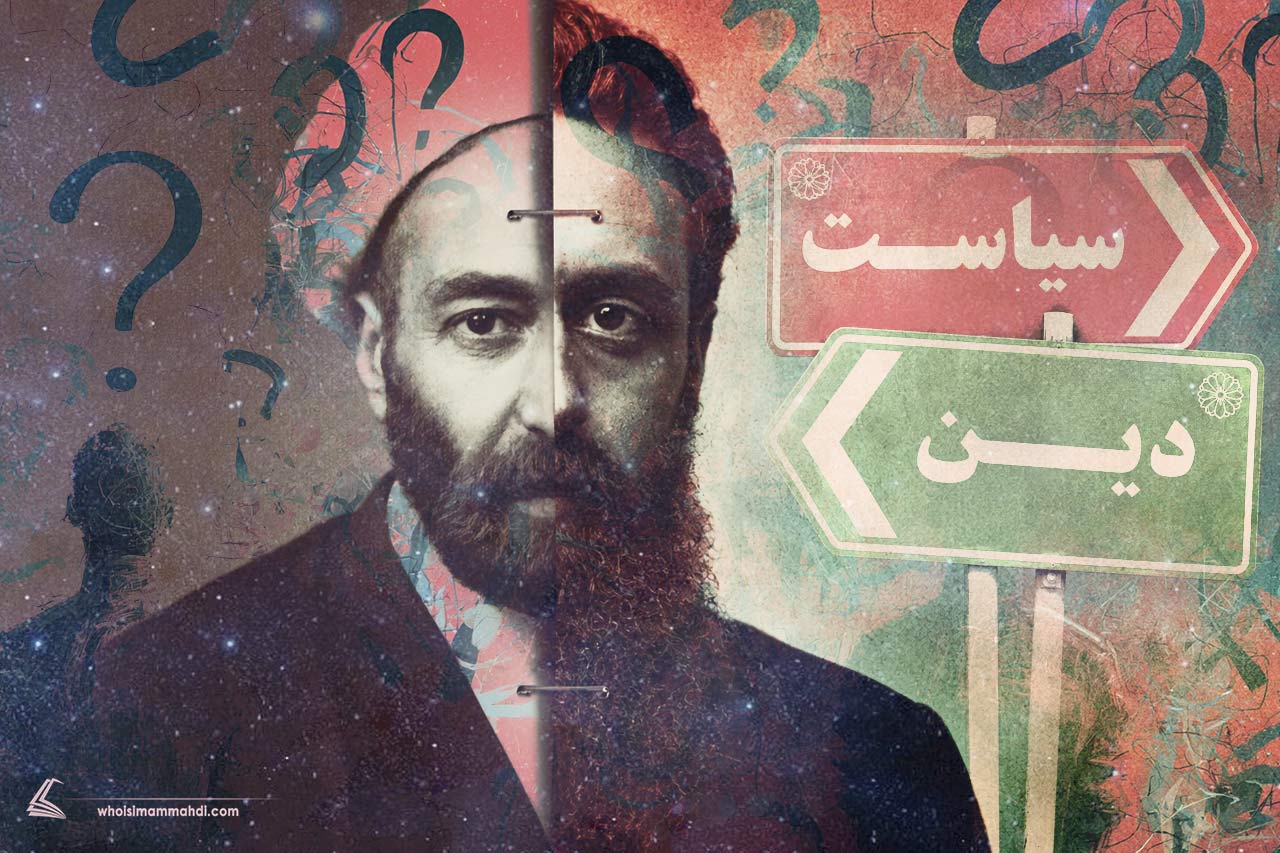
Separation of Religion from Politics
The Hojjatieh Society maintains that politics should be separate from religion and that one should refrain from political involvement [4]. However, this stance itself can be seen as a form of cunning politics. When a group prioritizes its own interests over divine criteria, it is inherently engaging in politics! Contrary to their claims, members of the Hojjatieh Society actively pursue government positions and seek political influence—a concern that Imam Khomeini (RH) consistently warned against.
If God’s purpose in sending religions was merely to bind people to outward practices of faith, such as prayer, fasting, and pilgrimage, then none of the Ahl al-Bayt (Peace be upon them) would have been martyred! In such a scenario, the tragedy of Ashura would not have occurred, as Yazid and Ibn Ziyad were also observant of prayer and fasting!
Furthermore, how can a society that claims to avoid political involvement justify its alignment with anti-Iranian groups like the People’s Mojahedin Organization of Iran, British Shiism, and Hezbe Khalq-e Mosalman? Is supporting these movements not a form of political engagement?
Illegitimacy of Establishing a Government During Occultation
The Hojjatieh Society frequently cites some hadiths from Shia texts asserting that establishing any government before the rule of Imam Mahdi (May Allah hasten his reappearance) is tantamount to disbelief [5]. However, it is essential to scrutinize the authenticity of any hadith before relying on it. Regardless of the validity of these narrations, it is crucial to understand the purpose behind Imam Khomeini’s uprising and the establishment of the Islamic Republic. According to the Infallible Imams (Peace be upon them), rejected uprisings are those lacking divine goals, occurring at inappropriate times, or led by someone falsely claiming to be the Mahdi (May Allah hasten his reappearance) [6].
Therefore, uprisings with divine objectives that do not contradict these three conditions are not only permissible but may also receive divine support. Historical examples include the uprisings led by Zayd ibn Ali, Mukhtar al-Thaqafi, and Yamani [7].
Moreover, the necessity for governance is an obvious reality for humanity; without it, society descends into chaos. If Muslims do not establish their own independent governance, they will inevitably fall under the control of non-believers. Would God Almighty desire such a fate for His faithful servants?
It is important to note that establishing an Islamic government is not only permissible during the period of occultation but is also essential. Even during the time of the Imam’s presence, a jurist who does not have direct access to him can still establish governance. Interestingly, the late Mirza Mahdi Isfahani—whom Hojjatieh members regard as their leader—also held this belief.
From what we’ve discussed, it is clear that establishing a divine government during the period of occultation is not just acceptable, but necessary and essential for preparing for the appearance of Imam Mahdi (May Allah hasten his appearance). If the advent were to occur without any preparation and readiness, simply at God’s will, there would be no reason for Imam Mahdi (Peace be upon him) to remain in occultation for over a thousand years! Thus, merely praying for his advent without taking action to remove obstacles is futile. As God has stated, He does not change the fate of a people until they change themselves.
Lack of Belief in the Guardianship of the Jurist
When someone fails to grasp the necessity of establishing a government, they will naturally struggle to understand the need for the guardianship of the jurist. According to Shiite teachings, when ideal governmental conditions are lacking, we must strive to create the closest possible state to those conditions. Therefore, the most qualified individual should assume leadership as the guardian jurist and work towards upholding Islamic laws. However, the Hojjatieh Society seeks to undermine the position of the guardianship of the jurist by claiming that their clerics focus solely on individual aspects of a Shiite’s life while neglecting their social responsibilities and global events that could weaken the Islamic community. Generally speaking, clerics affiliated with this society often convey the idea that there is no responsibility placed on individuals during the period of occultation [8].
From their perspective, Islam has no role in civilization, nor does the Iranian nation play a part in building it! Ironically, Hojjatieh clerics not only oppose Western civilization but also promote it.
Promotion of Oppression and Corruption as a Prelude to the Reappearance of Imam Mahdi (May Allah hasten his reappearance)
The need for government and social life is one of humanity’s most fundamental needs. A government must provide the necessary conditions for individuals’ spiritual and moral growth while defending their rights. Numerous verses in the Quran state that if God did not prevent some people through others, oppression and corruption would prevail in society. God emphasizes that certain individuals must exist to invite others toward goodness. Therefore, it is evident that God has never intended for the earth to be filled with oppression and immorality.
Furthermore, if no one is to challenge oppression and corruption, should we then forget the laws and principles of Islam—which the Prophet (Peace be upon him) labored for 23 years to implement—during the period of occultation? What happens to the Quranic verses regarding defense, jihad (struggle in the cause of God), and enjoining good while forbidding wrong? For God has never allowed a situation where non-believers dominate believers. Another question arises: how could God send Islam as a religion meant for all people throughout all times yet place no duty on individuals regarding its preservation?
Influential Figures, Positions, and Activities of the Hojjatieh Society
As mentioned earlier, the Hojjatieh Society continued its activities even after its apparent dissolution. Among its board members were Mahmoud Halabi, Mohammad Salehi Azari, and Seyyed Hossein Sajjadi, who conducted their meetings in private homes or religious centers. Following Mahmoud Halabi’s death in 1997, Seyyed Hassan Eftekhari Zadeh assumed the presidency until his own passing in 2024.
Since its inception, the Hojjatieh Society has consistently opposed the front of truth. This opposition is evident not only in its significant support for SAVAK and the Pahlavi regime but also in events like the 1963 demonstrations in Iran (the 15 Khordad protests), Abolhassan Banisadr’s betrayal, and the Jebhe Melli (National Front of Iran). Even during Iraq’s invasion of Iran, their stance remained unchanged. In the years following the revolution, Hojjatieh members, holding various government positions, publishing houses, and schools, have covertly fostered divisions between Shia and Sunni communities through sermons and mourning ceremonies for the Ahl al-Bayt (Peace be upon them), while also training forces against the principles of Islamic Revelation.
One of the key characteristics of a true believer is the ability to recognize enemies and understand the times they live in—something Hojjatieh members have consistently failed to do. When the Iranian people were risking their lives and properties to fight against the Pahlavi regime, the Hojjatieh Society identified the Baha’i faith as their primary enemy. In the aftermath of the Iranian Revolution, as Western culture began to infiltrate Iranian universities and educational institutions, they chose to focus on combating Marxism instead of addressing this infiltration.
Today, as global Zionism continues to perpetrate violence against Muslims daily, the Islamic community is in dire need of unity and solidarity; yet, Hojjatieh members have chosen to label Wahhabism—the offspring of Zionism—as their main adversary. While freedom seekers around the world, including non-Muslims, rally for the liberation of Palestine and express their outrage at Israel, Hojjatieh members—who claim to follow the path of Imam Hussein (Peace be upon him)—remain silent, believing that these atrocities must escalate for Imam Mahdi (May Allah hasten his reappearance) to appear!
In this article, we explored the formation of the Hojjatieh Society, its beliefs, positions, and activities. We examined their ideology and contrasted it with the concept of true awaiting as outlined in the Quran, traditions, and logic. What doubts or questions have you encountered regarding this topic? We invite you to share your thoughts with us!
References
[1]. Cohen, Ronen A. The Hojjatiyeh Society in Iran. Palgrave Macmillan, 2013. 68-69.
[2]. Cohen, Ronen A. The Hojjatiyeh Society in Iran. Palgrave Macmillan, 2013. 68.
[3]. Olyanasab, S. Z., and H. Bagheri. “Analysis of the Narrative Bases of the Opponents of Revolution and Formation of Islamic Government in the Period of Occultation.” Contemporary Researches on Islamic Revolution, vol. 2, no. 3, 2020, pp. 1-16.
[4]. Cohen, Ronen A. The Hojjatiyeh Society in Iran. Palgrave Macmillan, 2013. 75-76.
[5]. “Hadith 8.1.452.1, and 22.2.5.9.“ Thaqalayn.net.
[6]. Al-Mufid, Shaykh. Kitab Al-Irshad: The Book of Guidance into the Lives of the Twelve Imams. Translated by I.K.A. Howard, Ansariyan Publications, 2005.
[7]. al-Saduq, Sheikh. Uyun Akhbar al-Ridha. Translated by Dr. Ali Peiravi, Ansariyan Publications, 2008. / Majlisi, Muhammad Baqir al-. Bihar al-Anwar. vol. 46, ch. 11, hadith 22/ vol. 45, ch. 49, p. 509/ vol. 48, ch. 48, p. 230.
[8]. Cohen, Ronen A. The Hojjatiyeh Society in Iran. Palgrave Macmillan, 2013. 78-79.
[i] A precautionary denial or dissimulation of religious faith