
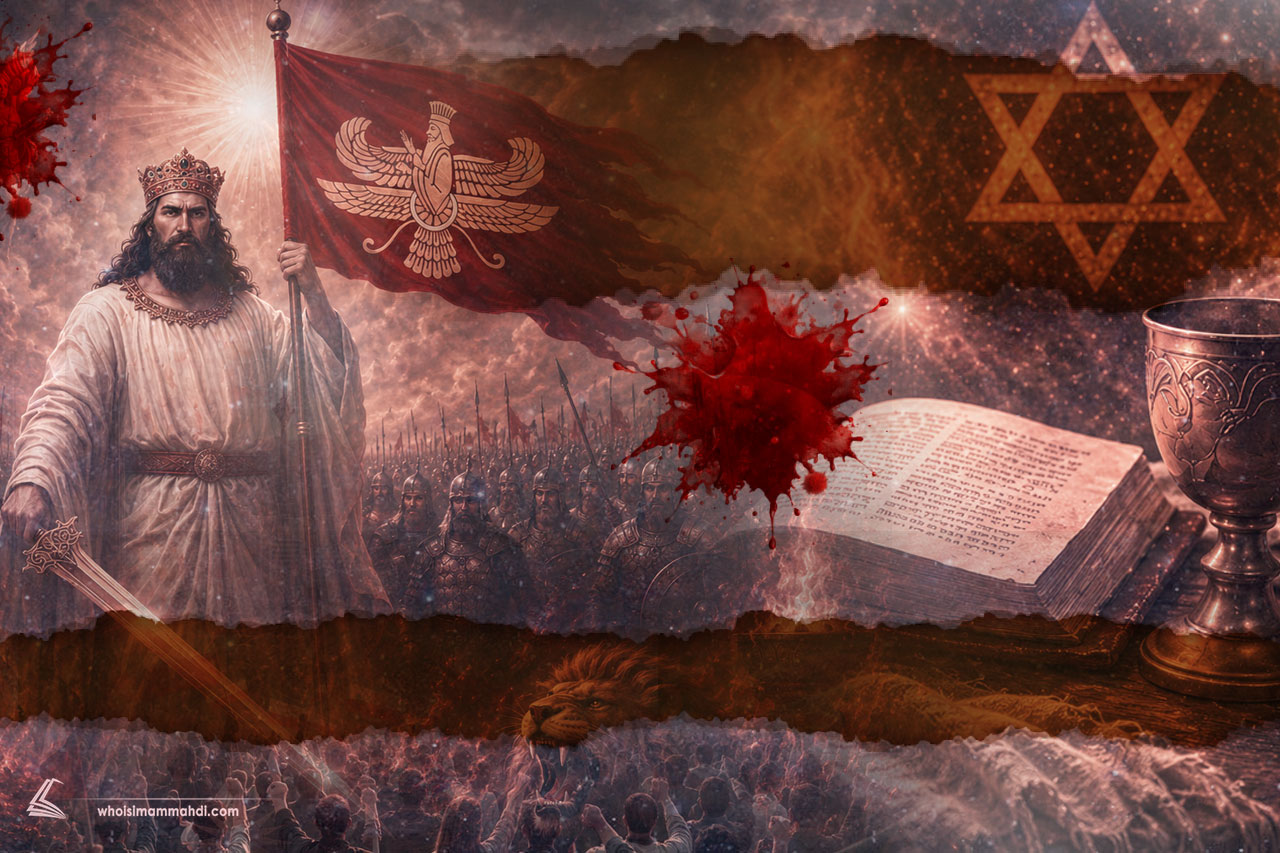
Overview of Jewish History and Influence in Ancient Persia
History presents contradictory and controversial theories regarding Cyrus II (Cyrus the Great). Historical sources frequently mention that he served the Jewish people and saved them from exile and humiliation. The goal of this article is not to refute or confirm these various theories about Cyrus, but rather to observe the questionable nature of the evidence within its complex and often ambiguous historical context. Only through this critical perspective can one evaluate the reality behind these contradictions, avoid ideological prejudice, and understand the extent and underlying motives of Jewish influence in ancient Persia.
Historical records indicate that the Jewish population found itself in dire conditions during the Babylonian siege and conquest of Jerusalem, where Nebuchadnezzar II imposed harsh and unbearable circumstances upon them. In these circumstances, Cyrus the Achaemenid intervened as a liberator, ending their captivity and subsequently facilitating their return to Jerusalem (Finkel; The Bible, Ezra 1:1-4).
Similarly, the strategic relationship between the Jews and subsequent Achaemenid monarchs continued to evolve. This historical connection extended into the Parthian and Sasanian eras, leaving a lasting impact on the social and administrative structures of ancient Iran.
Relations Between Cyrus and the Jews Throughout History
Various theories exist regarding the true character and political motivations of Cyrus. Native Persian historical records provide no specific information about him. However, foreign historiography records that he defeated the Medes around 550 BCE and established a powerful empire. Subsequently, he attacked Babylon in 539 BCE and issued a decree liberating the Jews from Babylonian captivity. This decree has often been celebrated as a foundational declaration of human rights. Cyrus also funded the return of the Jews to Jerusalem and the rebuilding of the destroyed Temple from the imperial treasury, while granting them freedom in choosing their place of residence—a policy that led many to settle within Persia itself, thereby laying the groundwork for Jewish settlement and potential influence in Persia (Johandi 3-25; Grabbe 355).
Based on historical writings, other possibilities exist regarding the reason for Cyrus’s special attention to the Jews. Some historians suggest that Cyrus had affinal (marital) ties with the Jewish community. For instance, Al-Masudi noted that Cyrus married an Israelite woman, which served as his personal motive for aiding the Jews (Al-Mas‘ūdī 63). Ibn Al-Balkhi likewise recorded that Cyrus’s mother was the daughter of one of the Israelite prophets (Ibn Al-Balkhī 53). Concurrently, other scholars view Cyrus’s support for the Jews as a pragmatic geopolitical strategy to secure his western frontiers and consolidate control over Babylon.
Prior to the mid-twentieth century, public awareness and historiographical emphasis on Cyrus remained relatively limited outside specialized scholarly circles and religious texts (Merhavy 933-48). Aside from a few monumental stone inscriptions, Jewish scriptures, and Classical Greek historiography, very little was widely circulated regarding Cyrus. The formal recording of events related to Cyrus began primarily with Greek historiography, most notably Herodotus (Schmitt).
Consequently, modern understanding of Cyrus is derived predominantly from Greek sources—such as Herodotus, Ctesias, and Xenophon—alongside biblical books and cuneiform inscriptions (Dandamayev).
The Faith and Beliefs of Cyrus
Jewish tradition remembers Cyrus as an anointed savior of the Jewish people and has promoted this narrative extensively throughout history. However, several conflicting narratives exist regarding Cyrus’s actual religious beliefs, none of which can be stated with absolute certainty.
Certain accounts praise him immensely, attributing sublime ethics and humanistic ideals to him, describing his religion metaphorically as humanity (Rattini). Others view him as a strict monotheist, with some scholars identifying him as a divine prophet or equating him with Dhul-Qarnayn mentioned in the Quran (Tabataba’i 353).
Conversely, another body of evidence suggests that Cyrus practiced polytheistic royal pragmatism, pointing to the inclusion of Babylonian deities in the Cyrus Cylinder, where he explicitly praises idols and gods such as Marduk (Van der Spek 10-21). Furthermore, Mary Boyce argues that Cyrus presented himself as a champion of Zoroastrianism (Boyce 43).
Overall, one of the primary drivers of Cyrus’s imperial success was his religious tolerance, through which diverse ethnic groups and religious factions—from monotheists to polytheists—were granted royal favor. This constituted a sophisticated piece of statecraft. If one accepts that all religious institutions were respected out of political expediency for the survival and consolidation of Achaemenid rule, the large volume of contradictory historical reports regarding his personal faith becomes understandable (Wiesehöfer 15-22). These political accommodations may also serve as evidence distinguishing his historical governance from that of strictly religious prophets. This pragmatic approach is further corroborated by Herodotus, who records that Cyrus rallied the Persians by presenting a forged document—purportedly from Astyages himself—appointing him as commander of the Persian forces. By using this calculated fabrication to incite a revolt against Median rule, Cyrus demonstrated a willingness to employ deception as a strategic tool for power consolidation (Herodotus, 1.125-126). Such political subterfuge underscores the fundamental distinction between his governance and the role of a religious prophet, who is typically defined by divine revelation and moral rigidity.
Relations of Darius and Xerxes with the Jews
Following the foundational policy of repatriation established by Cyrus II, subsequent Achaemenid rulers maintained structured administrative relationships with the Jewish population across the empire. Under Darius I and Xerxes I, these interactions became increasingly institutionalized within the administrative framework of the Near East. In biblical historiography, particularly in Ezra and Isaiah, Cyrus’s policies toward the Judean exiles are presented within a framework of divine providence: Ezra depicts Cyrus as permitting the exiles to return and rebuild the Temple in Jerusalem, while Isaiah presents him as an anointed ruler chosen by God to fulfill this purpose (Segal 34).
Despite royal permission to return to Jerusalem, a significant portion of the Jewish population chose to remain in Mesopotamia and Persia proper. Early administrative documents recovered from Babylonia, notably the archive of the Egibi family, provide empirical evidence of Jewish participation in financial and banking activities, real estate transactions, and imperial agricultural management during the reigns of Cambyses II, Darius I, and Xerxes I (Pearce 230-43).
During the reign of Darius I, imperial consolidation integrated Jewish elites further into the administrative structure. Biblical accounts record the reissuing of official authorization and the completion of the Second Temple under his rule (The Bible, Ezra 6:1-15), demonstrating administrative continuity and institutional respect for earlier royal decrees.
The reign of Xerxes I in Jewish tradition is closely associated with the events recorded in the Book of Esther, which forms the narrative foundation of the Purim festival. This text recounts court intrigues involving Mordecai, Queen Esther, and the court minister Haman, ultimately leading to a royal decree permitting Jews throughout the imperial provinces to defend themselves (The Bible, Esther 8:11).
The Book of Esther and the Origins of Purim
The Book of Esther provides the literary foundation for the Jewish festival of Purim. According to the narrative, the events took place at the court of Ahasuerus, the Persian king whose name is commonly identified with Xerxes I. The account claims Esther, a Jewish woman who became queen, and her relative Mordecai thwarted Haman’s plan to destroy the Jews throughout the Persian Empire. After the king authorized the Jews to defend themselves against those who sought to attack them, the Jews killed their enemies throughout the empire. According to the Book of Esther, 75,000 of their enemies were killed in the provinces, while 500 were killed in Susa on the first day and another 300 on the following day. The ten sons of Haman were also killed. The narrative, therefore, presents a large-scale slaughter of those identified as enemies of the Jews and describes the festival of Purim as being based on the presumed slaughter of large numbers of Persians (Shaked; McCullough).
Shaul Shaked notes that there is no independent corroboration for the principal events of the narrative, and doubts have, therefore, been raised concerning its historical reliability. At the same time, the book contains a number of Persian names and appears to reflect knowledge of the Achaemenid royal court and its cultural setting. Thus, although the Book of Esther cannot be treated as an independently confirmed account of Achaemenid history, it remains an important literary source for understanding the influence of Jewish communities and their experience within the Persian imperial world.
The festival is observed on the fourteenth and fifteenth days of the Jewish month of Adar, with the fifteenth traditionally observed in Jerusalem and certain other walled cities. Some scholars have proposed an Iranian influence on Purim, while others have questioned such interpretations. The similarity between the names Esther and Mordecai and the Babylonian deities Ishtar and Marduk has also led to theories concerning a Babylonian background for the festival. However, these similarities alone cannot establish a Babylonian origin. The same source notes that the Book of Esther presents Purim as a commemoration of the Jews’ deliverance from a planned massacre and that the festival is based, according to the narrative, on the slaughter of large numbers of Persians (Arkun et al.; Shaked).
Thus, in Jewish tradition, Purim is celebrated as a commemoration of the Jews’ deliverance and victory over their enemies during the reign of the Persian king Ahasuerus. According to the narrative preserved in the Book of Esther, this victory involved the killing of large numbers of those who had sought to destroy the Jews (Esther 9:18). However, while its historical accuracy is subject to criticism, what remains evident from the narrative is the Jewish influence in ancient Persia and the massive slaughter of Persians, which is celebrated as a triumph over the enemies of the Jews.
Jewish Communities During Parthian and Sasanian Rule
Jewish influence in ancient Persia continued to evolve during the Parthian era (Arsacids), when Jewish communities enjoyed broad religious autonomy alongside social and economic stability. Unlike Christian populations in the later Roman realm, Jewish groups in Babylonia were generally viewed as loyal subjects not aligned with Rome (Goodblatt).
With the rise of the Sasanian dynasty in 224 CE and the establishment of Zoroastrianism as a state-sponsored institution, tensions initially arose regarding judicial jurisdiction and public rituals. Early Sasanian clashes with portions of the Jewish population stemmed from jurisdictional disobedience and religious zealotry; imperial authorities responded with punitive measures and restricted certain public rituals. Taxation was a significant source of tension between Jewish communities and the Sasanian state; Persian taxes were required to be paid, while some Jewish leaders resisted the payment of the head-tax imposed on minority communities (Neusner 100; Neusner, Jewish Exilarchate).
Another primary point of contention was the Jewish demand for autonomous judicial courts, whereas the Sasanian state sought to unify society under a centralized legal system. However, during the reign of Shapur I, judicial privileges were formally recognized on the condition of submission to overarching Sasanian civil law (Neusner 96-103). Generally, the Jewish desire for communal autonomy frequently generated complex interactions with the broader imperial society.
Tensions were further heightened by messianic expectations within Jewish communities. Belief in the approaching arrival of the savior (Mashiach) repeatedly catalyzed political mobilization and armed resistance against both Sasanian and Byzantine authority throughout Late Antiquity (Gafni 142-50). In the early sixth century, the Exilarch Mar Zutra II led an armed revolt in Babylonia to establish an independent Jewish enclave, motivated by messianic expectations and local political instability (Neusner 95-105). Similarly, during the Byzantine–Sasanian War of 614 CE, Jewish forces aligned with Khosrow II’s army to capture Jerusalem, seeking to rebuild the Temple (Stoyanov 35-48).
Despite periodic internal friction, Jewish communities generally supported the Iranian state during conflicts between the Sasanian and Roman empires. During the campaigns of Khosrow II (Khosrow Parviz), Jewish groups actively backed the Sasanian military, playing a notable role in the capture of Jerusalem; in return, Khosrow Parviz granted them administrative participation in specific areas of Palestine (Avi-Yonah 259-70).
Eventually, a stable coexistence was established through the leadership of Jewish Exilarchs and rabbinic scholars. Intermarriages between royal and aristocratic families—such as the marriage of Yazdegerd I to Queen Shushandokht, daughter of the Exilarch—further highlight the integration of Jewish elites into the Iranian political landscape during Late Antiquity (Herman 162-80; Neusner 7-12).
Modern Reinterpretation and Historiographical Evolution During the Pahlavi Era
In the twentieth century, the policy of the Pahlavi state sought to construct a secular national identity centered on Iran’s pre-Islamic heritage. This policy placed special emphasis on the Achaemenid era, elevating Cyrus II into a foundational symbol of national statehood. The culmination of this historiographical strategy was manifested in the 2,500-year celebration of the Persian Empire in 1971 (Ansari 408-14).
The historical connection between Jews and ancient Persia received renewed political and academic focus during the Pahlavi regime. The dynasty, seeking to establish deep historical legitimacy, drew upon ancient historical narratives, bringing the figure of Cyrus to the forefront of national consciousness. Through engineered political framing, the regime promoted the concept of a 2,500-year-old continuous monarchy, highlighted historical Jewish connections to ancient Persia, and initiated a new trajectory in modern Iranian historiography by leveraging nationalist sentiments and creating a dichotomy between religious identity and pre-Islamic national heritage.
During this period, archaeological excavations by Western scholars—such as Ernst Herzfeld, Roman Ghirshman, and David Stronach—alongside diplomatic interactions, brought Jewish-Iranian connections into sharper focus. The ideology of Cyrus-centrism and the 2,500-year celebrations were deeply aligned with Zionist diplomatic goals. The official music for the celebrations was composed by the Israeli composer Ezra Kia, and prominent international Zionist figures attended the ceremonies, seeking to highlight the historical narrative of Cyrus’s service to the Jewish people (Pour Arian and Delashub 19-40).
The historical evidence suggests that Jewish influence in ancient Persia cannot be understood through a single narrative. Its forms and significance varied across the Achaemenid, Parthian, Sasanian, and Pahlavi periods and were repeatedly reshaped by political, religious, and historiographical circumstances. From an ideological perspective, a key objective of magnifying Cyrus and promoting pre-Islamic nationalism was to create a counterweight against Shia Islamic identity within Iran. According to Zionist protocols, Zionism has always viewed Shia Islamic doctrine as a major impediment to their broader geopolitical objectives and their interpretation of messianic leadership. Because the Iranian national identity, rooted in Islamic principles, maintains a belief in divine leadership and the preparation for a monotheistic civilization, ideological attempts to alter these cultural paradigms through pre-Islamic nationalistic narratives represented a strategic alignment of Pahlavi and international Zionist interests.
Works Cited
Al-Mas‘ūdī. Murūj al-Dhahab wa Ma‘ādin al-Jawhar. Translated by Aloys Sprenger, vol. 1, Oriental Translation Fund, 1841.
Ansari, Ali M. “A Royal Romance: The Cult of Cyrus the Great in Modern Iran.” Journal of the Royal Asiatic Society, vol. 31, no. 3, 2021.
Arkun, Aram, Moojan Momen, and Amnon Netzer. “Festivals vi, vii, viii.” Encyclopaedia Iranica, https://www.iranicaonline.org/articles/festivals-vi-vii-viii/.
Avi-Yonah, Michael. The Jews under Roman and Byzantine Rule: A Political History of Palestine from the Bar Kokhba War to the Arab Conquest. Magnes Press, The Hebrew University, 1984.
Boyce, Mary. A History of Zoroastrianism, Volume 2: Under the Achaemenians. Brill, 1982.
Dandamayev, Muhammad A. “CYRUS iv. The Cyrus Cylinder.” Encyclopædia Iranica, https://www.iranicaonline.org/articles/cyrus-iv/.
Finkel, Irving, editor. The Cyrus Cylinder: The King of Persia’s Proclamation from Ancient Babylon. I.B. Tauris, 2013.
Gafni, Isaiah. The Jews of Babylonia in the Talmudic Era: A Social and Cultural History. Project Talmud, 1990.
Goodblatt, David. “Judeo-Persian Communities iii. Parthian and Sasanian Periods.” Encyclopædia Iranica, https://www.iranicaonline.org/articles/judeo-persian-communities-iii-parthian-and-sasanian-periods.
Grabbe, Lester L. A History of the Jews and Judaism in the Second Temple Period, Volume 1: Yehud: A History of the Persian Province of Judah. T&T Clark, 2004.
Herman, Geoffrey. A Prince Without a Kingdom: The Exilarch in the Sasanian Era. Mohr Siebeck, 2012.
Herodotus. The Histories. Translated by A. D. Godley, LacusCurtius, https://penelope.uchicago.edu/Thayer/E/Roman/Texts/Herodotus/1B.html.
Ibn Al-Balkhī. The Fársnáma of Ibnuʼl-Balkhí. Edited by G. Le Strange and R. A. Nicholson, E.J.W. Gibb Memorial Series, New Series 1, Luzac, 1921.
Johandi, Andreas. “Marduki ja Jahve soosik: Pärsia kuningas Kyros II ja tema taevased patroonid Vana Testamendi tekstides ja Kyrose silindril.” Usuteaduslik Ajakiri, vol. 70, no. 2, 2016.
McCullough, W. S. “Ahasuerus.” Encyclopaedia Iranica, https://www.iranicaonline.org/articles/ahasureus/.
Merhavy, Menahem. “Religious Appropriation of National Symbols in Iran: Searching for Cyrus the Great.” Iranian Studies, vol. 48, no. 6, 2015.
Neusner, Jacob. A History of the Jews in Babylonia, Vol. V: Later Sasanian Times. Brill, 1970.
Neusner, Jacob. “Jewish Exilarchate.” Encyclopaedia Iranica, 20 July 2005, updated 14 Mar. 2012, http://www.iranicaonline.org/articles/jewish-exilarchate/.
Neusner, Jacob. “Judeo-Persian Communities iii. Parthian and Sasanian Periods.” Encyclopædia Iranica, vol. XV, fasc. 1, 2008.
Pearce, Laurie E. “Cuneiform Sources for Judeans in Babylonia in the Neo-Babylonian and Achaemenid Periods: An Overview.” Religion Compass, vol. 10, no. 9, 2016.
Pour Arian, F., and H. Delashub. “Nature of the 2500-Year Celebrations of Monarchy in Viewpoint of Imam Khomeini.” Matin Research Journal, vol. 13, no. 51, 2010.
Rattini, Kristin Baird. “Cyrus the Great: History’s Most Merciful Conqueror?” National Geographic, 6 May 2019, https://www.nationalgeographic.com/culture/article/cyrus-the-great.
Schmitt, Rüdiger. “Cyrus iii. Cyrus II The Great.” Encyclopedia Iranica, https://www.iranicaonline.org/articles/cyrus-iii.
Segal, Alan F. “The Second Temple Period.” The Cambridge Guide to Jewish History, Religion, and Culture, edited by Judith R. Baskin and Kenneth Seeskin, Cambridge University Press, 2010.
Shaked, Shaul. “Esther, Book of.” Encyclopaedia Iranica, https://www.iranicaonline.org/articles/esther-book-of.
Stoyanov, Yuri. The Persian Conquest of Jerusalem in 614 CE: Messianic Expectations and Religious Conflict. Institute for Cultural Research, 2011.
Tabataba’i, Muhammad Hussein. Al-Mizan. Academic Press Co., 1995.
The Holy Bible. King James Version / New International Version.
Van der Spek, R. J. “The Cyrus Cylinder and the Interpretation of Its Text.” Edited by Irving Finkel, British Museum Press, 2013.
Wiesehöfer, Josef. Ancient Persia: From 550 BC to 650 AD. I.B. Tauris, 1996.